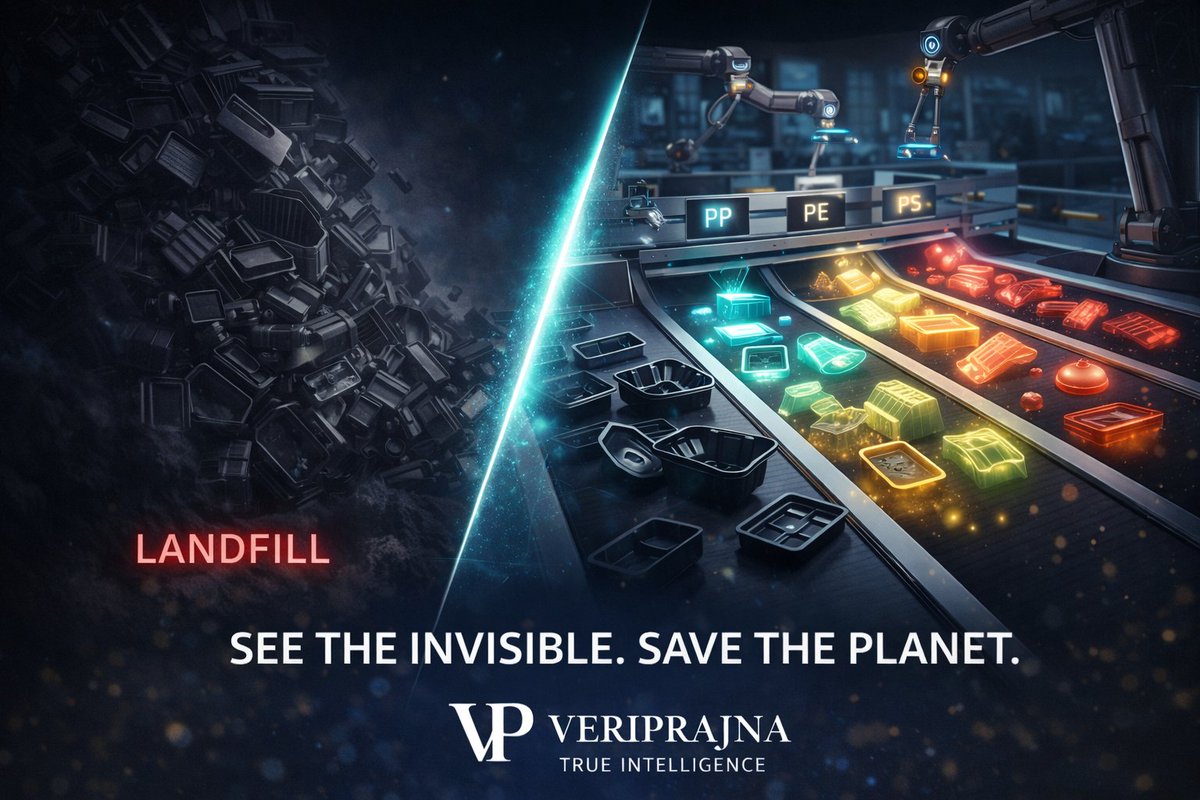
- Millions of tons of black plastics are rejected from recycling every year.
Not because they can't be recycled. Not because they lack value (recycled black PP = $1,200/ton).
Because NIR sensors literally cannot see them. The information never reaches the AI.
Thread 🧵 - #Recycling #AI
The issue: Carbon black pigment.
It's used in ~15% of the plastic waste stream (food trays, electronics, automotive parts).
Carbon black absorbs Near-Infrared (NIR) light—the wavelength standard optical sorters use.
No reflection = no signal = no data. - #CircularEconomy
Standard NIR operates at 0.9-1.7 µm.
When NIR light hits black plastic, carbon black pigment absorbs it before it can interact with the polymer beneath.
Sensor receives: Zero return signal. Flatline. Indistinguishable from the black conveyor belt. - Physics, not software.
This is where "AI wrappers" fail catastrophically.
You can't prompt GPT-4 to classify a null signal. You can't hallucinate data that was never captured at the sensor layer.
If the contrast doesn't exist in the photons, no amount of clever ML saves you. - #DeepTech
A mid-sized Materials Recovery Facility (MRF) processing 50,000 tons/year:
• Black plastic content: 5% (2,500 tons)
• Current fate: Incineration at €100/ton = -€250K cost
• Lost revenue: €2.25M annually
The invisible waste costs millions.
#WasteManagement - Veriprajna shifts to Mid-Wave Infrared (MWIR): 2.7-5.3 µm.
At this wavelength, carbon black becomes sufficiently transparent.
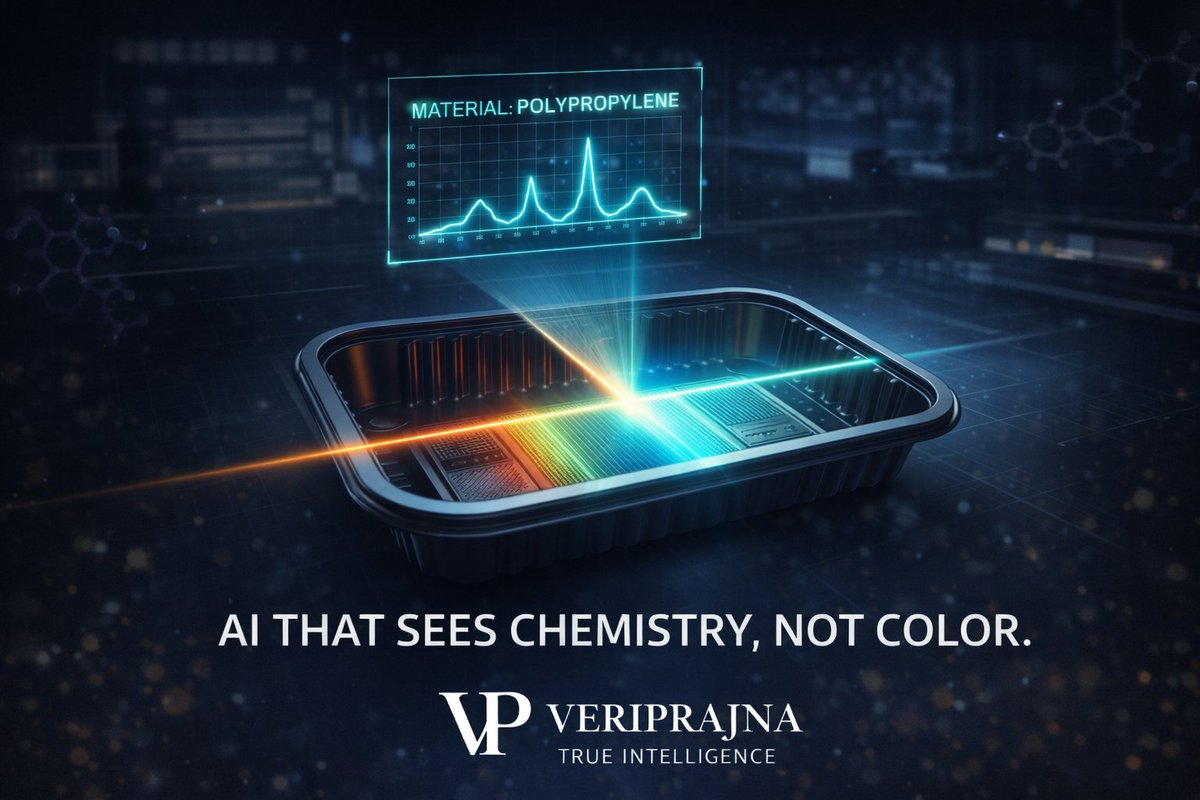
The sensor "looks through" the pigment, seeing the polymer's fundamental vibrations—its chemical fingerprint.
Same plastic. Different physics. - We deploy the Specim FX50—a cryogenic hyperspectral camera.
• InSb/MCT detector cooled to 77 Kelvin (Stirling cooler)
• 154 spectral bands at 380fps
• Captures polymer C-H stretching, C=O bonds
Black PP, PE, PS, ABS—each has distinct MWIR signature. All visible. - #HyperspectralImaging
Standard 2D-CNNs analyze spatial features (shape, texture). Useless for crushed, dirty waste.
Veriprajna uses 1D-CNNs—treating each pixel's spectrum as a 154-value signal, not an image.
We detect CHEMISTRY, not appearance. - Inference: <5ms. Edge computing. No cloud latency.
• Recovery rate: 90%+ (vs 0% with NIR)
• Classification accuracy: PP, PE, PS, ABS separation
• Latency: <5ms (real-time sorting at 3m/s belt speed)
• ROI: System pays for itself in <2 months - Economics + physics = no-brainer.
#Sustainability
This is Deep Tech, not wrapper AI.
We don't improve software on inadequate data. We re-engineer the sensor layer to capture reality standard systems miss.
Circular economy applications. Hyperspectral imaging. Spectral AI. - We'd welcome a strategic discussion.
📖 Read the full technical whitepaper here: https://veriprajna.com/whitepapers/seeing-invisible-black-plastic-recovery-mwir-hsi
📧 [email protected]
🌐 https://veriprajna.com
💬 WhatsApp: +919217059957