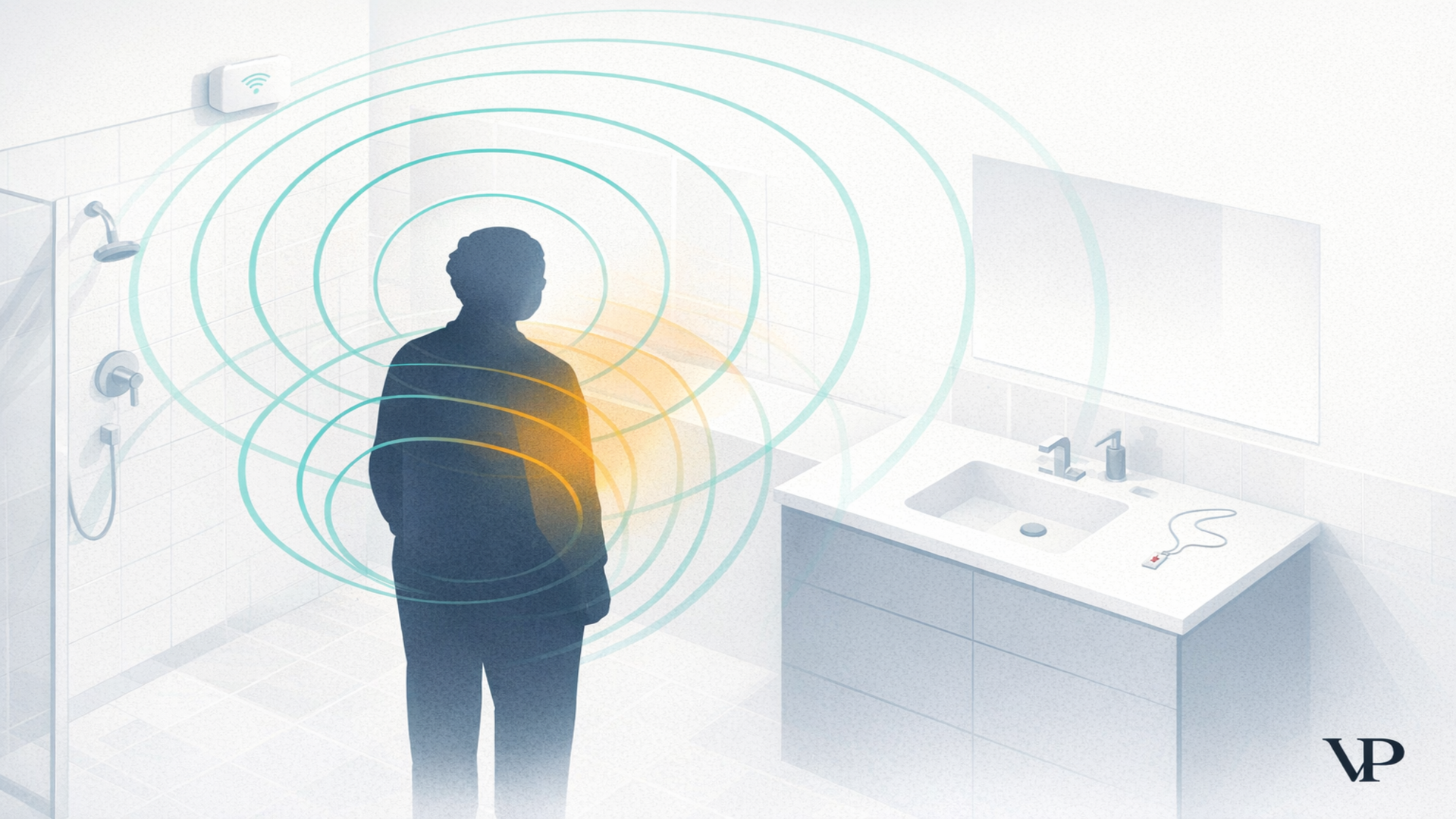
The most dangerous room in your grandmother's house is the bathroom. It's also the one room where her medical alert pendant is sitting on the vanity instead of around her neck.
This isn't a hypothetical. Studies show that only 14% of personal emergency response system users actually wear their device 24 hours a day. Another 24% never wear theirs at all. We've spent a decade building increasingly sophisticated wearable health monitors — better sensors, longer batteries, sleeker designs — and the people who need them most leave them in a drawer.
I've spent the last two years obsessing over this problem. Not the sensor problem. The human problem. And the answer, it turns out, was already in the air around us.
The Wearable Compliance Gap Nobody Talks About
The elder care industry has a dirty secret: its primary safety technology depends on the cooperation of people who are often cognitively or physically unable to cooperate.
Think about what we're asking. We're asking an 85-year-old with arthritis to plug a proprietary magnetic charger into a tiny port every night. We're asking someone with early-stage dementia to remember to put on a device every morning. We're asking a person who grew up in an era before waterproof electronics to trust that their expensive watch won't break in the shower — and even when the device is rated IP68, a lifetime of habit wins. The watch comes off. The pendant stays on the counter.
Roughly 30% of wearable health tracker users abandon their devices within six months. For the general population, that's a mild inconvenience. For an 87-year-old living alone, it's a gap in the safety net that nobody sees until something goes wrong.
The most effective health monitor isn't the one with the best sensors. It's the one that requires no interaction whatsoever.
There's a psychological dimension too. Qualitative research consistently shows that older adults view SOS pendants as a mark of frailty — something that "brands" them as old. Many hide the device under clothing, refuse to wear it in social settings, or avoid pressing the button during a genuine emergency because they're terrified of triggering a false alarm. The device designed to protect them becomes a source of anxiety.
When my team first mapped out these failure modes, the conclusion was uncomfortable but clear: the entire paradigm of strapping sensors onto elderly people and hoping for compliance is fundamentally broken.
What If Your Wi-Fi Could Listen to Your Breathing?
Every Wi-Fi router in your home is constantly sending radio waves that bounce off walls, furniture, and people. When those waves hit your body, your movements — even the tiny rise and fall of your chest as you breathe — distort the signal in measurable ways.
This is passive Wi-Fi sensing, and it's the technology I believe will replace wearables for elder care monitoring within the next decade.
The key is something called Channel State Information (CSI) — detailed data about how Wi-Fi signals travel from your router to your devices. Unlike the crude signal strength indicator your phone shows (those one-to-three bars), CSI captures the signal's behavior across dozens or hundreds of individual frequency channels simultaneously. It's the difference between hearing that "there's music playing" and being able to identify the individual instruments.
When a person walks through a room, their body creates a unique pattern of signal reflections. When they breathe, their chest wall moves just 4 to 12 millimeters — invisible to the eye, but at 5 GHz, that displacement represents a significant fraction of the radio wave's 6-centimeter wavelength. The signal oscillates in rhythm with the breath.
We explored this physics in depth in our interactive analysis of passive Wi-Fi sensing and deep AI, but the practical upshot is striking: experimental evaluations have shown respiratory rate estimation errors below 3.2 breaths per minute using standard Wi-Fi hardware, with advanced deep learning models achieving correlation coefficients above 0.92 compared to medical-grade respiratory belts.
Your router is already collecting the raw data. We just haven't been reading it.
Falls Have a Signature — And Wi-Fi Can Read It
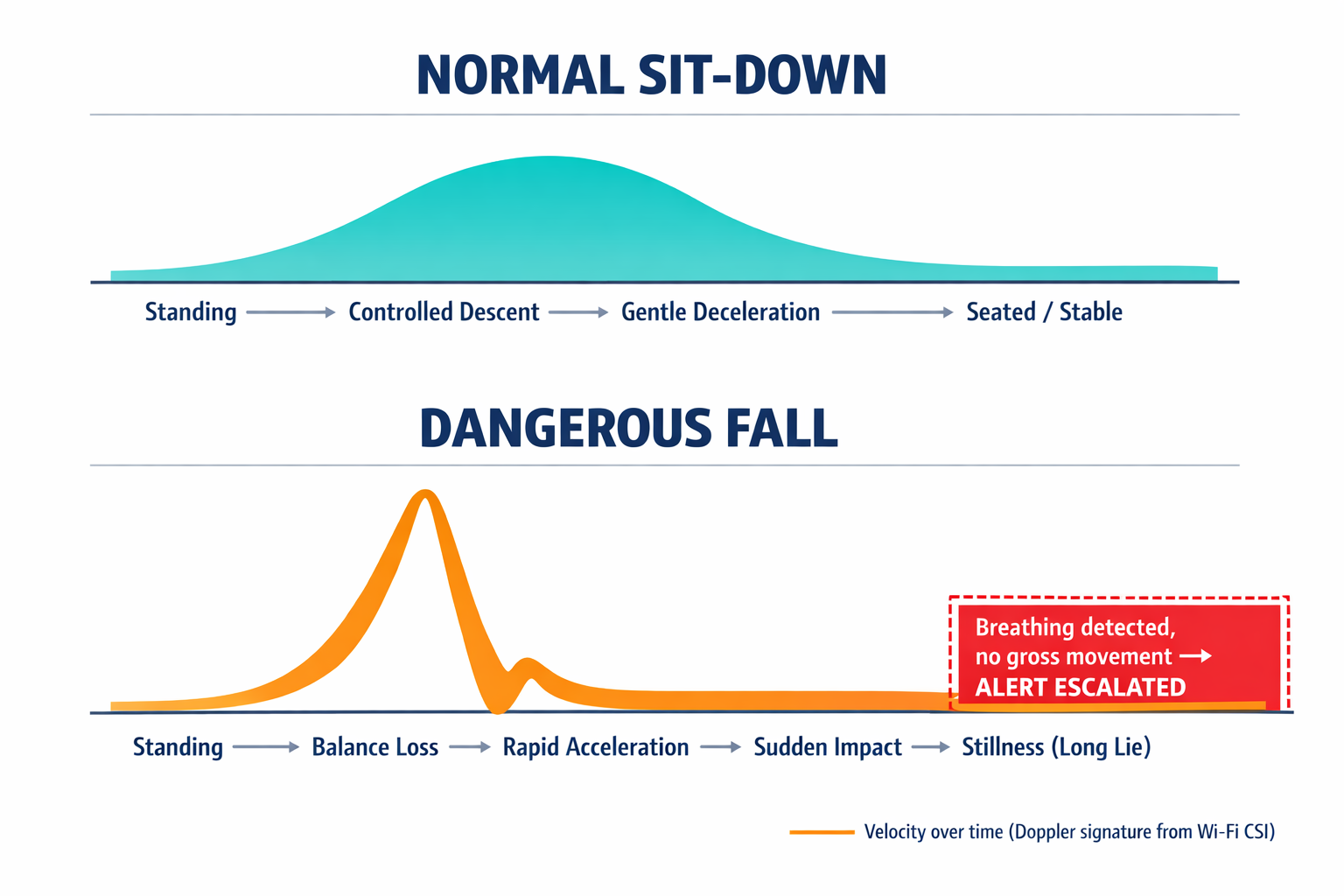
A fall isn't a single moment. It's a sequence: standing, losing balance, accelerating downward, impact, then stillness. Each phase creates a distinct Doppler signature in the Wi-Fi signal — the same frequency-shift effect that makes an ambulance siren change pitch as it passes you.
Walking produces a complex pattern of shifts as arms and legs swing toward and away from the router. A fall produces something different: a sudden, high-energy acceleration followed by an abrupt stop. By converting the Wi-Fi signal into a visual map of velocity over time (called a spectrogram), a trained AI model can distinguish a dangerous fall from someone sitting down quickly or dropping a book.
The real value, though, isn't just detecting the fall. It's what happens after.
The medical community has a term called the "Long Lie" — remaining on the floor for hours, unable to get up. This is often more dangerous than the fall itself, leading to dehydration, muscle breakdown, and pressure injuries. A Wi-Fi sensing system continues monitoring after the impact. If it detects micro-motion (breathing) but no gross motor movement at floor level, it confirms a "fall with inability to recover" and escalates the alert.
A wearable can tell you someone fell — if they're wearing it. Wi-Fi sensing can tell you someone fell, that they're still breathing, and that they haven't gotten up in twenty minutes.
Published research demonstrates fall detection sensitivity above 97% with Wi-Fi sensing, and the context-awareness significantly reduces false alarms compared to wearable accelerometers — which can't tell the difference between a person falling and a device being knocked off a nightstand.
Why GPT Can't Decode a Radio Wave
When I tell people we use AI for this, the first question is usually: "So, like ChatGPT?"
No. Not remotely.
Large Language Models are extraordinary at processing text. But CSI data isn't text. It's continuous, complex-valued, high-dimensional, and governed by physics, not grammar. Feeding raw radio frequency data into a language model would be like asking a literary critic to interpret an MRI scan.
This is where I get opinionated: the "AI" label has become so diluted that wrapping an API around a pre-trained text model now passes for innovation. For Wi-Fi sensing, that approach is useless. What you need is purpose-built deep learning — neural networks designed specifically for temporal signal processing.
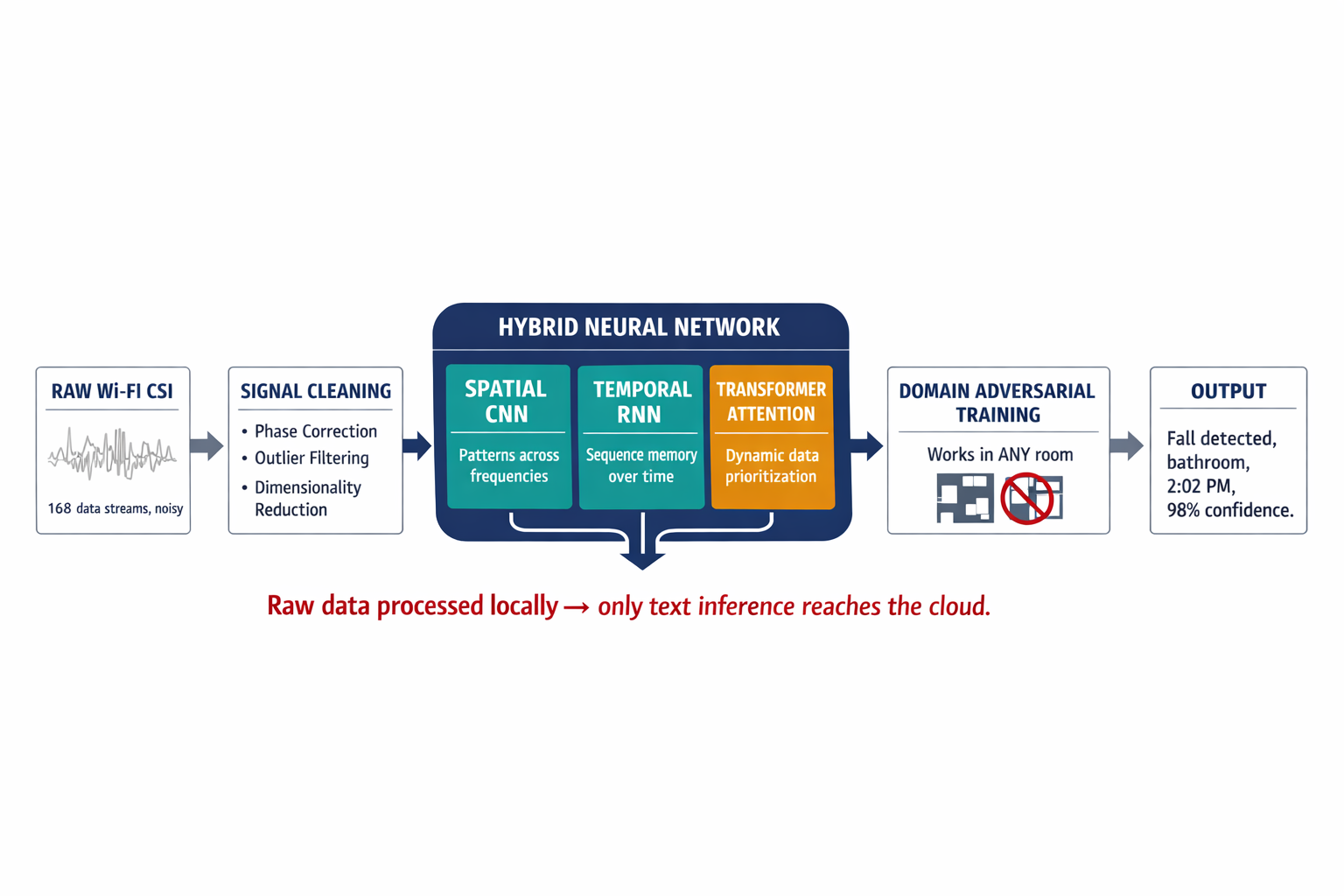
My team built a multi-stage architecture that works like this. First, we clean the raw signal. Wi-Fi chipsets produce noisy data corrupted by hardware imperfections and interference. We apply phase correction algorithms, outlier filters, and dimensionality reduction to extract the meaningful signal from the noise — turning 168 simultaneous data streams into the principal components that actually carry information about human movement.
Then we process it through a hybrid neural network. One component identifies spatial patterns across frequencies — recognizing, for instance, that a fall causes a simultaneous signal drop across a specific cluster of channels, while a spinning ceiling fan looks completely different. Another component tracks temporal sequences, maintaining memory of what happened seconds ago so it can distinguish the full arc of a fall from someone jumping on a bed. A third component — based on the same Transformer architecture that powers modern language models, but adapted for signal data — dynamically prioritizes the most relevant data stream. During sleep, it focuses on the subtle phase shifts that encode breathing. During activity, it shifts attention to the larger amplitude changes that capture movement.
The hardest problem, honestly, wasn't building the model. It was making it work in apartments it had never seen. A model trained in one room tends to memorize the specific way signals bounce off that room's walls and furniture. Deploy it somewhere new, and accuracy collapses.
We solved this with a technique called Domain Adversarial training — essentially forcing the AI to learn what a fall "looks like" in radio waves regardless of the room's geometry. The model is simultaneously trained to classify activities correctly while being deliberately prevented from identifying which environment it's in. The result is something closer to a universal fall signature that works in a studio apartment or a nursing home hallway. For the full technical methodology behind this architecture, see our detailed research on healthcare Wi-Fi sensing.
The Privacy Argument That Actually Wins
I expected the biggest objection to ambient monitoring to be privacy. Instead, it's the strongest argument in our favor.
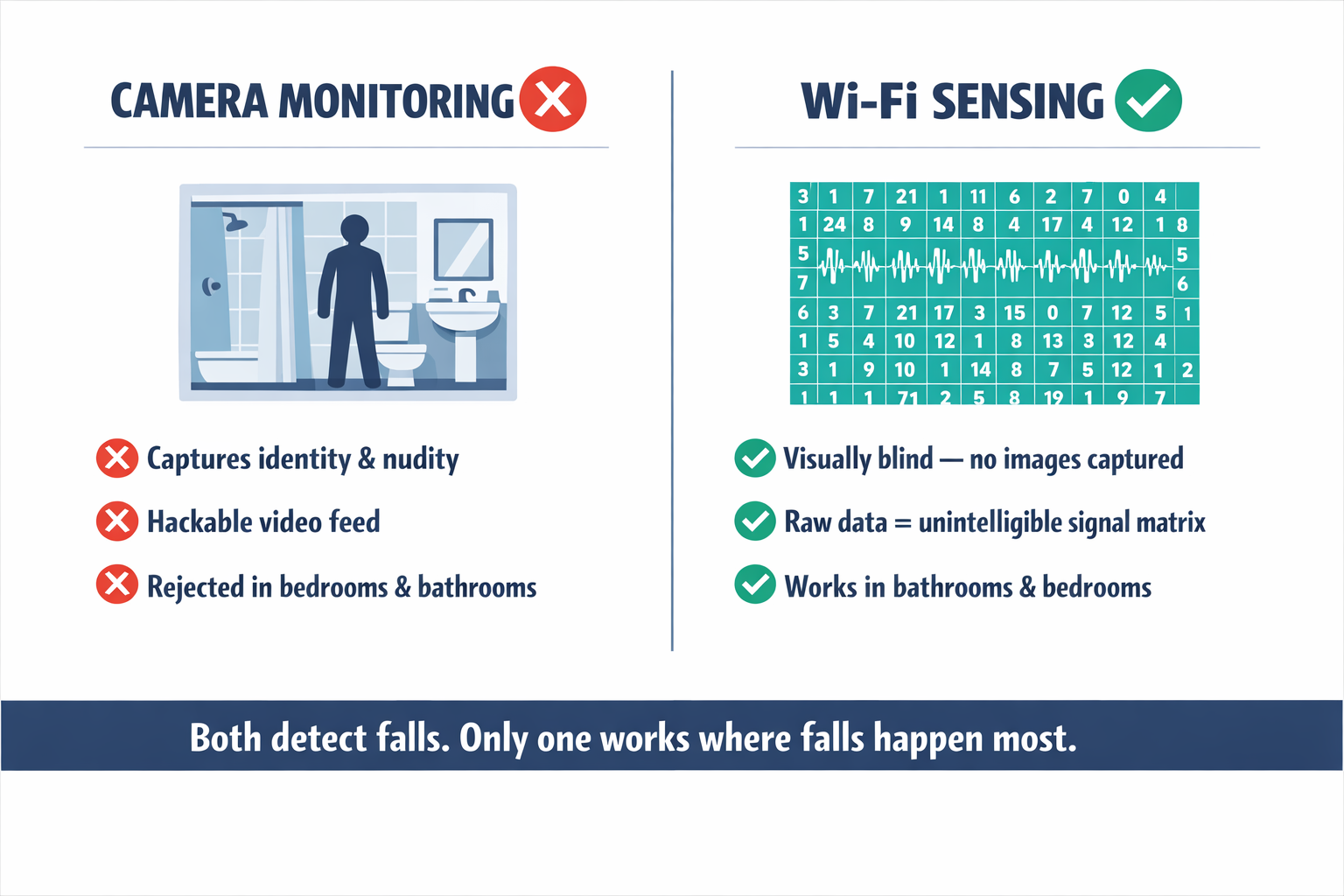
Cameras are effective monitors. They're also widely rejected in the spaces where monitoring matters most — bedrooms and bathrooms. The feeling of being watched, the risk of capturing nudity, the possibility of a hacked video feed — these aren't abstract concerns for elderly people or their families. They're dealbreakers.
Wi-Fi sensing is visually blind. The data consists of complex numbers representing signal propagation. Even if someone intercepted the raw data stream, they wouldn't see a face or a body — just a matrix of unintelligible signal measurements. This makes it uniquely suitable for bathroom monitoring, which is exactly where the highest fall risk exists and cameras are strictly prohibited.
Wi-Fi sensing monitors the most dangerous room in the house — the one where every other technology fails or isn't allowed.
For enterprise clients, the compliance story is equally clean. Raw CSI data never leaves the building. It's processed locally on the Wi-Fi access point or an edge gateway, and only the inference — a simple text string like "Fall detected, bathroom, 2:02 PM, 98% confidence" — is transmitted to the cloud. That string contains no biometric data and can't be reverse-engineered to identify anyone's physiology. Under GDPR, CSI qualifies as biometric data requiring explicit consent, but our edge-processing architecture means the sensitive data is discarded milliseconds after analysis, never stored, never transmitted.
The Zero-Hardware Retrofit
For nursing homes and assisted living facilities, the economics are almost absurdly favorable.
These buildings already have enterprise-grade Wi-Fi networks. They've already paid for the infrastructure. Passive Wi-Fi sensing transforms that existing communication network into a safety network through a software deployment. No wearables to purchase, lose, or replace. No batteries to change. No cameras to install in sensitive spaces. No proprietary sensors to drill into walls.
The upcoming IEEE 802.11bf standard (WLAN Sensing) will formalize this capability, ensuring future Wi-Fi chipsets natively support sensing — turning every router into a standardized radar. Major chipset manufacturers like Qualcomm and Broadcom are already building neural processing units directly into their Wi-Fi silicon, enabling the AI models to run on the router itself.
A software update can enable fall detection across 100 rooms simultaneously. That's a fundamentally different cost curve than deploying and managing thousands of individual devices.
What About Multi-Person Rooms and Pets?
Two objections come up consistently, and they're fair.
The first: what happens when two people are in the same room? Current Wi-Fi sensing works best for single-occupancy monitoring — a resident's bedroom, a bathroom. In shared spaces, the system reliably detects that a fall occurred but may struggle to attribute it to a specific individual without additional sensing links. Multi-person tracking is an active research frontier, and adding more Wi-Fi sensing nodes (some as inexpensive as $5 ESP32 microcontrollers) creates a denser signal mesh that improves separation. It's not fully solved, but for the primary use case — monitoring individual residents in their rooms — it's not a blocker.
The second: pets. A golden retriever moving through a room creates signal disturbances too. The Doppler signature of a four-legged animal walking is measurably different from a bipedal human — different limb swing patterns, different height, different velocity profile. Our models are trained to distinguish these patterns, though I'll be honest: a large dog lying very still on the floor can occasionally look ambiguous to the system. The temporal context helps — the model knows whether a human was present and moving moments before the stillness began.
Neither objection is trivial. Both are solvable. And neither changes the fundamental calculus: a monitoring system that works 95% of the time in every room, including the bathroom, beats a wearable that works 100% of the time but sits on a nightstand 86% of the day.
What This Means If You Run a Care Facility
If you operate an assisted living facility, a hospital-at-home program, or an insurance plan covering elderly populations, the practical implications are immediate:
Night rounds can become data-driven. Instead of waking every resident to check on them — disrupting the sleep you're simultaneously trying to monitor — staff can watch a dashboard for sleep disturbances or bed exits, attending only to residents who need help.
Gait deterioration becomes visible before the fall. By continuously tracking walking speed and stride consistency over weeks, the system can flag the subtle mobility decline that precedes a fall, enabling preventative physical therapy instead of reactive emergency response.
Liability exposure drops. If your facility claims 24/7 monitoring but a resident falls while their wearable is charging, you have a legal problem. Infrastructure-based sensing that can't be removed or forgotten eliminates that gap.
The air in every room is already full of information about the people in it. The Wi-Fi signals are already bouncing off their bodies, encoding their breathing, their movement, their stillness. We've just been ignoring it.
I don't think we will for much longer.
If you're working on ambient monitoring, aging-in-place technology, or the operational side of elder care, I'd genuinely like to hear what you're seeing on the ground. The compliance gap is real, and I suspect every facility operator reading this has a story about the pendant that was in the drawer when it mattered most.