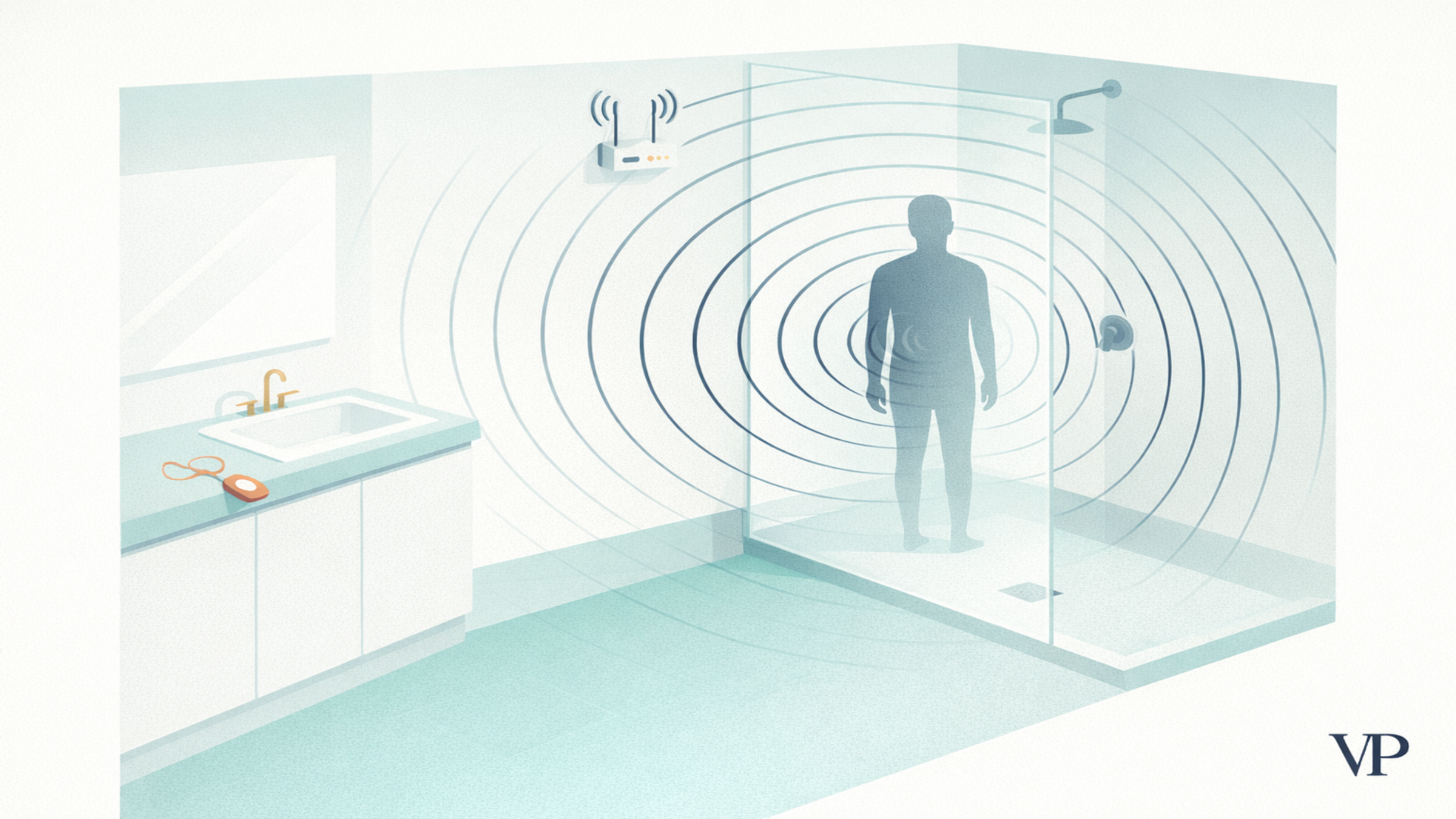
The most dangerous room in your grandmother's house is the bathroom. It's where slippery surfaces and hard fixtures cause the most injurious falls among older adults. It's also the one room where she takes off her medical alert pendant before stepping into the shower.
This isn't a hypothetical. Research shows that only 14% of personal emergency response system users achieve true 24-hour adherence — meaning 86% of the time, someone is unprotected during some portion of their day. And roughly 30% of users abandon their wearable health trackers within six months entirely. The people most at risk of a medical emergency are the least likely to be wearing the device designed to save them.
We call this the compliance crisis, and it's the reason our team has spent the past several years focused on a radically different approach: passive Wi-Fi sensing — turning the radio signals already bouncing around every home into an invisible safety net that detects falls, monitors breathing, and analyzes sleep. No wearable. No camera. No effort from the person being protected.
The Wearable Assumption Is Broken
The entire model of remote patient monitoring assumes the user will cooperate. Charge the device every night. Remember to put it on every morning. Keep it on in the shower. Press the panic button during an emergency.
For a healthy 68-year-old, that's manageable. For an 87-year-old with arthritis and mild cognitive impairment, it's an engineering fantasy.
We've identified three failure points that make wearables unreliable for the populations that need them most:
The "Shower Paradox." Despite water-resistance ratings, many older adults remove devices before bathing — a lifetime habit from owning non-waterproof electronics. The device sits on the vanity while the fall happens in the tub.
Charging fatigue. Plugging in a proprietary magnetic charger requires fine motor skills that decline with age. The device gets left on the nightstand "just for today" and stays there for a week.
Stigma. Qualitative research consistently finds that older adults view SOS pendants as branding them as frail. They hide the device under clothing, leave it home when visitors arrive, or refuse to wear it in social settings.
The best health monitor isn't the one with the most sensors. It's the one that requires no interaction at all.
For enterprise operators — nursing homes, assisted living facilities, hospital-at-home programs — these aren't just usability problems. They're liability problems. A facility claiming 24/7 monitoring while residents' devices sit uncharged in drawers faces real legal and reputational exposure.
How Wi-Fi Becomes a Sensor
Every Wi-Fi router is already doing something remarkable: transmitting radio waves that bounce off every surface in your home — walls, furniture, and your body. Those reflections carry information. The question is whether you're listening.
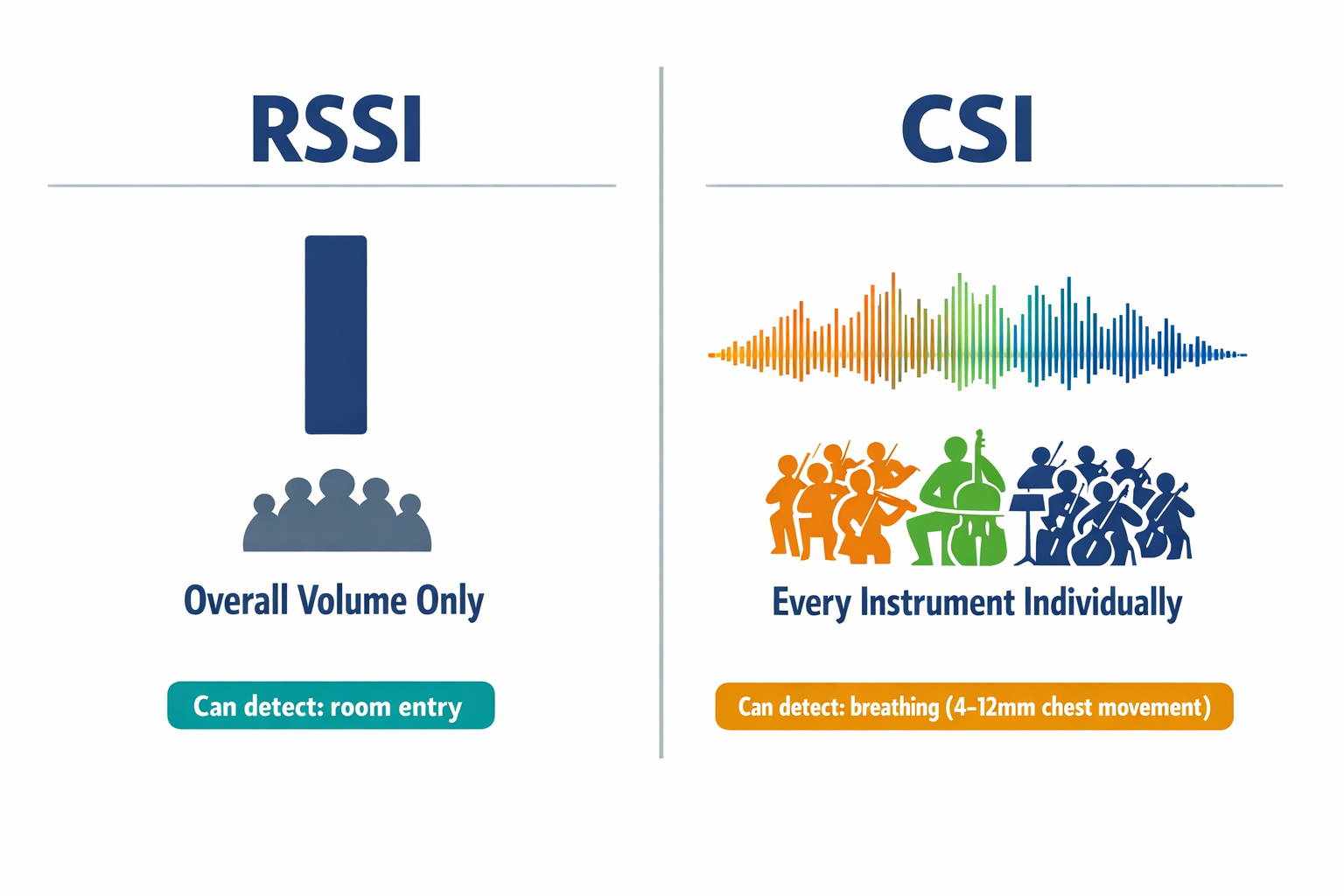
Older approaches tried using Received Signal Strength Indication (RSSI) — essentially, how loud the Wi-Fi signal is when it arrives. But RSSI is crude. It can tell you someone walked into a room, but a microwave oven or a humid day can fool it just as easily. It certainly can't tell you if someone is breathing.
The breakthrough comes from Channel State Information (CSI), a much richer data layer available in modern Wi-Fi standards. Think of it this way: RSSI is like knowing the overall volume of an orchestra. CSI is like hearing every individual instrument — the violins, the cellos, the oboes — each on its own channel. Modern Wi-Fi splits its signal across dozens or hundreds of subcarriers, and CSI captures exactly how each one is affected by the environment.
When a person moves through a room, their body reflects these radio waves. Different movements create different patterns in the CSI data. And the sensitivity is extraordinary: at 5 GHz, the Wi-Fi wavelength is about 6 centimeters, which means a movement of just 3 centimeters — half a wavelength — produces a detectable shift in the signal.
That's significant because the human chest moves 4 to 12 millimeters during normal breathing. Invisible to the eye from across the room. Clearly visible to Wi-Fi.
We explored this physics in depth in our interactive analysis of passive Wi-Fi sensing and deep AI, which walks through how Fresnel zones and Doppler signatures make this detection possible.
Breathing, Falling, Sleeping — Without a Single Device
The practical applications fall into three categories, each with measurable clinical value.
Respiratory monitoring is perhaps the most surprising. By tracking the rhythmic oscillation that breathing creates in CSI phase data, our algorithms can reconstruct a breathing waveform. Experimental evaluations show respiratory rate estimation errors below 3.2 breaths per minute, with advanced deep learning models achieving correlation coefficients exceeding 0.92 against medical-grade respiratory belts. This opens the door to continuous, non-contact screening for conditions like sleep apnea — currently requiring an overnight stay in a sleep lab with sensors strapped to the patient's body.
Fall detection goes beyond the moment of impact. A fall has a kinematic signature: loss of balance, rapid downward acceleration, sudden impact, then stillness. Wi-Fi sensing captures this entire sequence as a Doppler signature — a pattern of frequency shifts caused by the body's velocity. Research demonstrates detection sensitivity above 97%. But the real value is what happens after the fall. The system continues monitoring. If it detects micro-motion (breathing) but no gross motor movement at floor level, it confirms a "fall with inability to recover" — what clinicians call the "Long Lie" — and escalates the alert. Remaining on the floor for hours causes rhabdomyolysis, dehydration, and pressure ulcers. Detecting the Long Lie, not just the fall, is what saves lives.
A wearable dropped on the floor registers as a fall. Wi-Fi sensing knows the difference between a dropped device and a person who can't get up.
Sleep analysis rounds out the picture. By measuring body movement intensity and breathing patterns throughout the night, the system classifies sleep stages, tracks how long it takes someone to fall asleep, and monitors bed exits — critical for dementia patients who wander at night.
Why This Requires Deep AI, Not an LLM
Raw CSI data from a Wi-Fi chipset is noisy, complex-valued, and high-dimensional. It's corrupted by hardware imperfections — clock synchronization errors between transmitter and receiver, random packet loss, electrical interference. You can't feed it into a chatbot and ask "did someone fall?"
This is why we draw a hard line between what we call Deep AI — purpose-built neural networks designed for signal processing — and the "LLM wrapper" approach that has become fashionable. A Large Language Model understands grammar and context in text. It has no capacity to interpret a 5 GHz waveform.
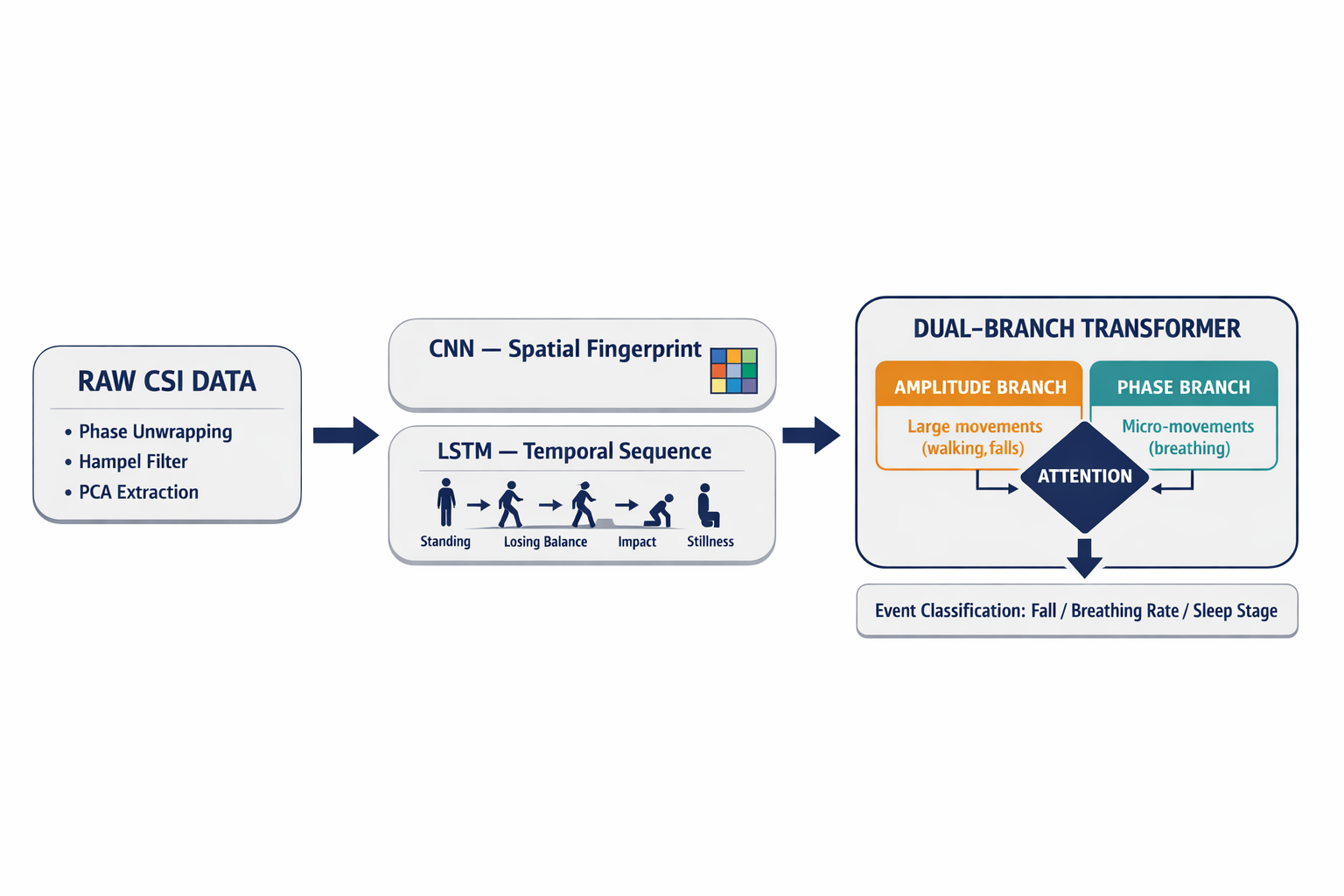
Our architecture works in layers. First, a rigorous preprocessing pipeline cleans the raw signal: unwrapping phase data, removing impulsive noise with Hampel filters, and using Principal Component Analysis to extract the signal components that actually carry motion information from the ones that carry noise.
Then the cleaned data moves through specialized neural networks. Convolutional Neural Networks (CNNs) treat the CSI data like an image — subcarrier frequencies on one axis, time on the other — and learn to identify the spatial "fingerprint" of different activities. Long Short-Term Memory (LSTM) networks add temporal context: they understand that a fall isn't a single moment but a sequence — standing, losing balance, descending, impact, stillness. Without that sequence awareness, a person jumping on a bed looks identical to a fall.
At the frontier of our work, we use a dual-branch Transformer architecture — one branch processing signal amplitude (for large movements like walking and falling), the other processing phase shifts (for micro-movements like breathing). An attention mechanism dynamically prioritizes whichever branch matters more in the moment. During sleep, the system leans on the phase branch. During activity, it shifts to amplitude.
For the full technical methodology behind this architecture, including our approach to domain adaptation, see our detailed research on healthcare Wi-Fi sensing.
The Room Problem — and How We Solved It
The historical knock against Wi-Fi sensing research has been fair: a model trained in one lab falls apart when you move it to a different apartment. The signal reflections change with every room layout, every piece of furniture, every wall material.
We address this with Domain Adversarial Neural Networks (DANNs) — a technique that trains the system with two competing objectives simultaneously. One part of the network tries to correctly identify the activity (fall vs. walk). The other part tries to identify which room the data came from. Then we force the system to succeed at the first task while deliberately failing at the second.
The result is a model that learns what a fall looks like regardless of environment — the universal signature rather than the room-specific one. This "train once, deploy everywhere" capability is what makes enterprise-scale deployment viable. You can't send an engineer to recalibrate every time a nursing home rearranges furniture.
Privacy by Physics
The most common objection we hear: "Isn't this just surveillance?"
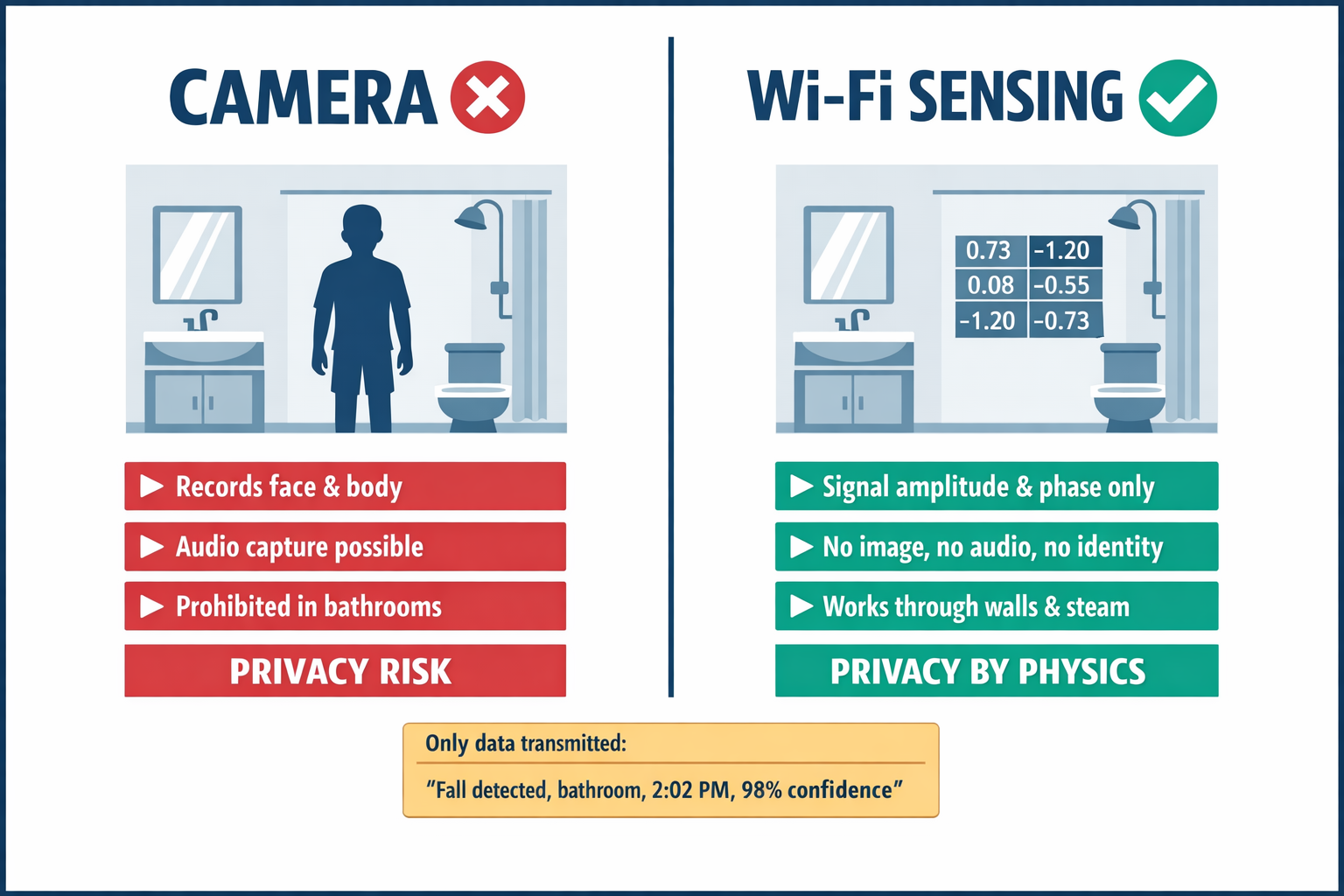
It's the opposite. Wi-Fi sensing is visually blind. The data consists of complex numbers representing signal propagation — amplitude values and phase angles. If a malicious actor intercepted the raw data stream, they would see a matrix of numbers. Not a face. Not a body. Not a conversation.
Even if someone hacked the data stream, they'd get a spreadsheet of signal measurements — not a single image of the person being monitored.
This is what makes Wi-Fi sensing uniquely suited for the bathroom — the most dangerous room in the house and the one place cameras are absolutely prohibited. The system works through steam, through shower curtains, through closed doors. Wi-Fi signals at 2.4 GHz and 5 GHz penetrate standard building materials with ease.
Under GDPR, CSI data is classified as biometric data (Article 9) because gait patterns could theoretically identify individuals. Our architecture handles this through edge processing: raw CSI is processed locally on the Wi-Fi access point or a local gateway. It is never transmitted to the cloud. The only thing that leaves the building is an abstracted event — a small data packet that says "Fall detected, bathroom, 2:02 PM, 98% confidence." No biometric signal. No reversible data.
What This Means for Facility Operators
For nursing homes and assisted living operators, the economics shift dramatically when monitoring moves from device-centric to space-centric.
The existing Wi-Fi infrastructure — already installed for connectivity — becomes the sensing layer. No capital expenditure on thousands of wearables. No logistics of replacing lost devices, changing batteries, or providing tech support to residents who can't pair a Bluetooth device. A firmware update or software deployment can enable fall detection across an entire facility.
The emerging IEEE 802.11bf standard (WLAN Sensing) is formalizing this transition, ensuring that future Wi-Fi chipsets natively support sensing capabilities. Chipmakers are already building the hardware: Qualcomm's Hexagon NPU enables on-router AI inference, Broadcom's BroadStream engine is purpose-built for sensing data, and Espressif's ESP32 platform (at roughly $5 per unit) enables dense mesh sensing in large facilities.
The operational impact compounds over time:
Preventative care. Continuous gait monitoring detects the gradual slowing of walking speed that predicts falls weeks before they happen — enabling physical therapy intervention instead of emergency room visits.
Smarter staffing. Night rounds become data-driven. Instead of waking every resident for a check, staff respond only to flagged events — better sleep for residents, better allocation for caregivers.
Reduced liability. Continuous, passive monitoring eliminates the gap between "we provide monitoring" and "the resident wasn't wearing the device."
What About False Alarms and Multi-Person Environments?
Two questions come up consistently. First: doesn't this generate constant false positives? The temporal sequencing built into our LSTM and Transformer models is specifically designed to reduce them. A wearable accelerometer that gets dropped on a tile floor registers as a fall. Our system tracks the full kinematic sequence — it knows the difference between a falling object and a falling person, and it confirms the Long Lie before escalating.
Second: what happens when multiple people are in the room? In standard configuration, the system tracks "presence" and "motion" without linking to a specific identity — it detects that someone fell, not who fell. Multi-person tracking with identity association is possible but requires explicit configuration and consent. For visitors, this is actually an advantage over cameras: the system detects that additional people are present without recording their faces or conversations, dramatically simplifying consent requirements.
The Air Is Already Full of Information
We've spent decades building wireless infrastructure to move data between devices. It turns out that same infrastructure has been quietly collecting data about the physical world — we just weren't reading it.
The compliance crisis in wearable health technology isn't a problem that better batteries or sleeker designs will solve. It's a structural flaw in the assumption that the most vulnerable people in our society should be responsible for managing their own monitoring systems. Passive Wi-Fi sensing removes that assumption entirely.
The air around us is already full of information. The question for healthcare operators, insurers, and facility managers isn't whether this technology works — the physics and the AI are proven. The question is how quickly you can stop relying on devices that sit in drawers while your residents are unprotected.
If your organization is wrestling with the gap between "monitored" and "actually safe," we'd welcome the conversation.