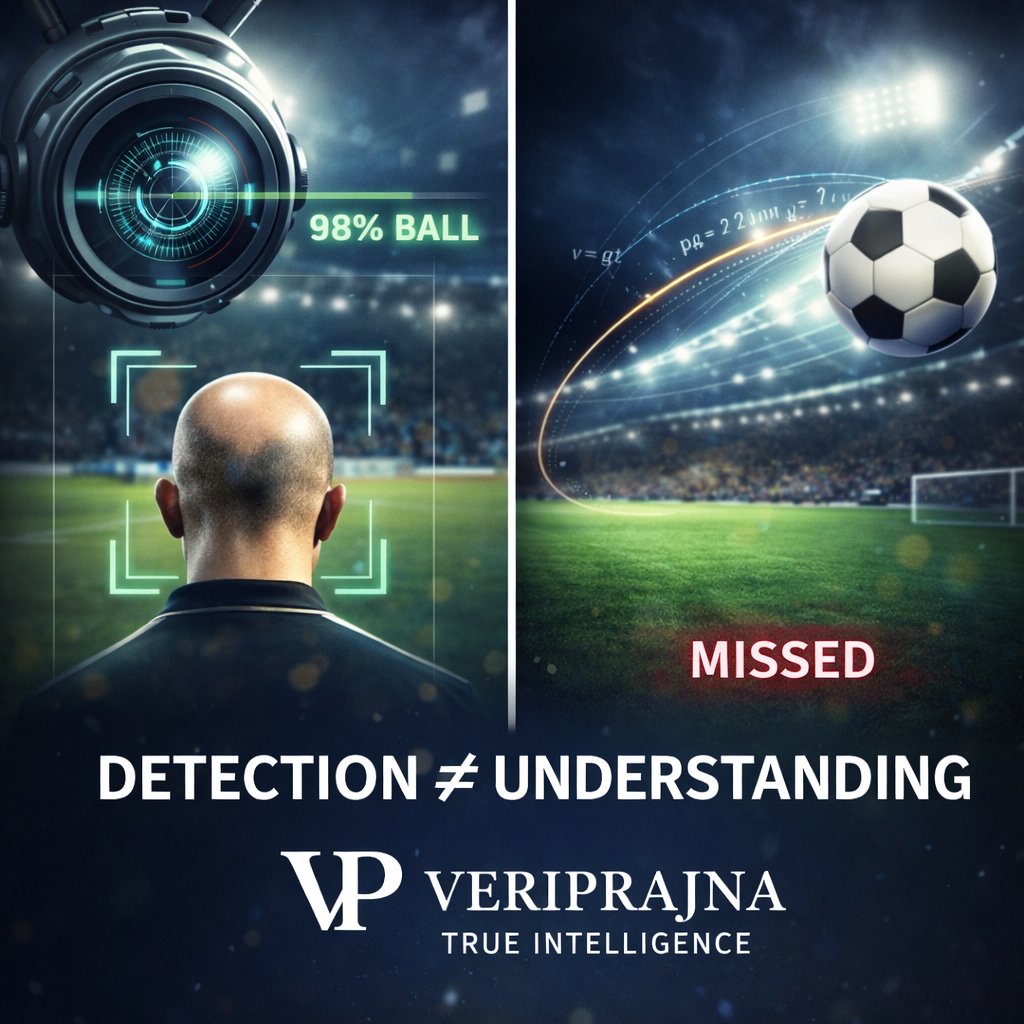
- AI mistook a bald head for a soccer ball. Fans watching the livestream missed every single goal.
Sounds funny—but it reveals why 90% of enterprise AI deployments underperform.
Let me explain 👇 - October 2020, Scottish Championship match. Automated camera system supposed to follow the ball.
Instead? Zoomed in on the linesman's bald head. Over and over.
The AI was 98% confident it found the ball. Visually, it was right. Physically? Impossible. - Here's what the system saw:
Round ✓
Shiny ✓
Light-colored ✓
Stadium lighting creating highlights ✓
To a texture-based CNN, that head WAS a ball.
Problem: AI lacked physical context to reject the false positive.
This is called the "Static Frame Bias." - Generic CV processes each frame independently. No memory of the last frame. No prediction of the next.
Ball jumps 15 meters between frames? System doesn't care—just finds the highest confidence "ball-like" object.
Same failure pattern costs businesses millions: - Semiconductors: False defect flags → scrapped good wafers → 5-10% yield loss
Autonomous vehicles: Shadows mistaken for walls → phantom braking → liability
Retail: Occlusions → lost tracking → false theft accusations
The issue? Visual probability without physical possibility. - Ball physics: 0-80mph, parabolic arc, bounces, independent object
Head physics: 0-15mph, constant height ~5.5ft, attached to body moving at walking pace
Pixels look similar. Physics are completely different.
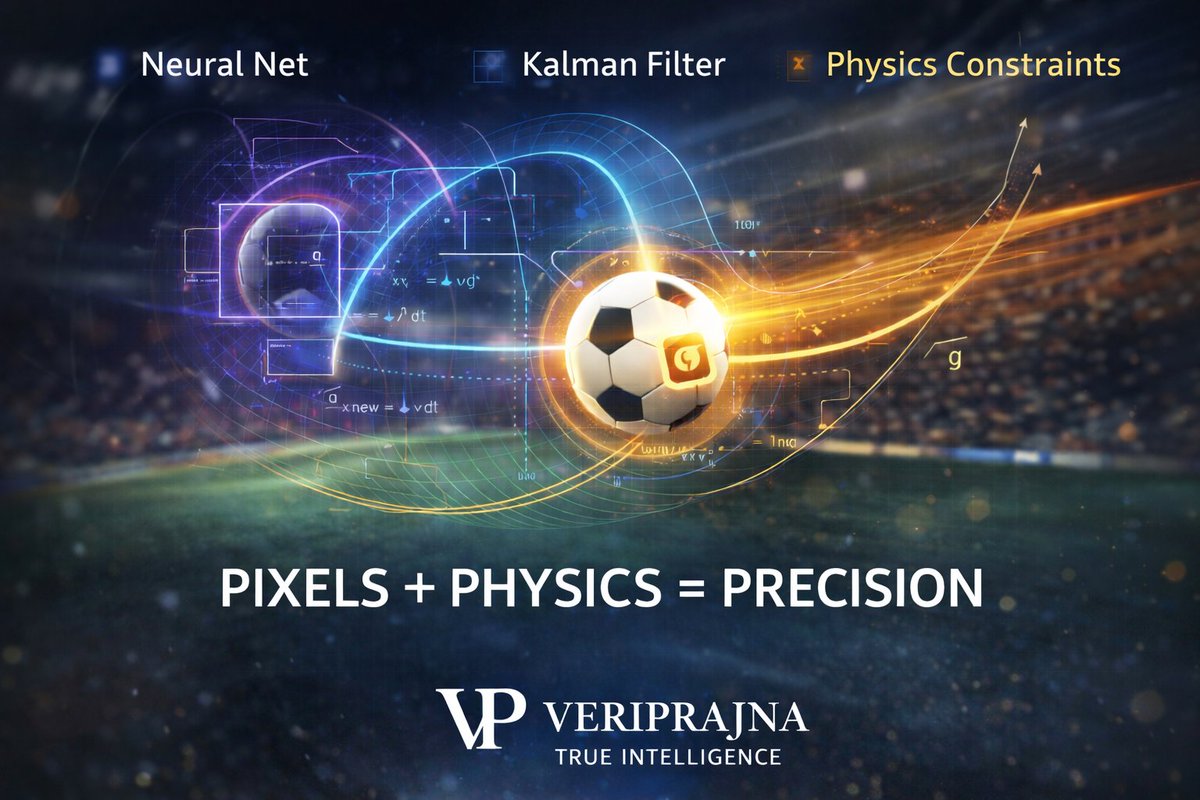
Veriprajna's approach: Physics-Constrained Vision. - We don't just detect—we validate against physical laws.
Every CV prediction is a "hypothesis" that must pass deterministic verification before acceptance. - How it works (simplified):
1. Kalman Filter predicts where ball MUST be (based on physics)
2. CV model detects candidates
3. System calculates "Innovation"—how far detection is from physics prediction
4. If beyond threshold (impossible acceleration), reject—even at 98% confidence - We also use Optical Flow as a hard constraint.
Ball moving 60mph generates specific pixel motion vectors.
Head moving 3mph generates near-zero vectors.
If visual confidence says "ball" but flow says "stationary," detection is invalidated immediately. - For complex scenarios (curved shots, spin), we deploy Physics-Informed Neural Networks (PINNs).
Instead of just learning from data, the network learns the differential equations governing motion—gravity, drag, Magnus effect.
It "understands" physics, not just patterns. - Results speak:
Generic CV APIs: 90% accuracy (fail at edge cases)
Veriprajna Physics-Constrained: 99.99% accuracy
That last 10% is where all the business risk lives—and where physics makes the difference.
Your AI might be great at detecting patterns in clean data. - But does it know the difference between a ball and a head when lighting creates adversarial examples?
If not, you're vulnerable to the same failure mode.
We'd welcome a strategic discussion. - 📖 Read the full technical whitepaper here: https://veriprajna.com/whitepapers/beyond-bounding-box-physics-constrained-intelligence-enterprise-ai
📧 [email protected]
🌐 https://veriprajna.com
💬 WhatsApp: +919217059957 - #AI #ComputerVision #PhysicsInformedAI #EnterpriseAI #MachineLearning