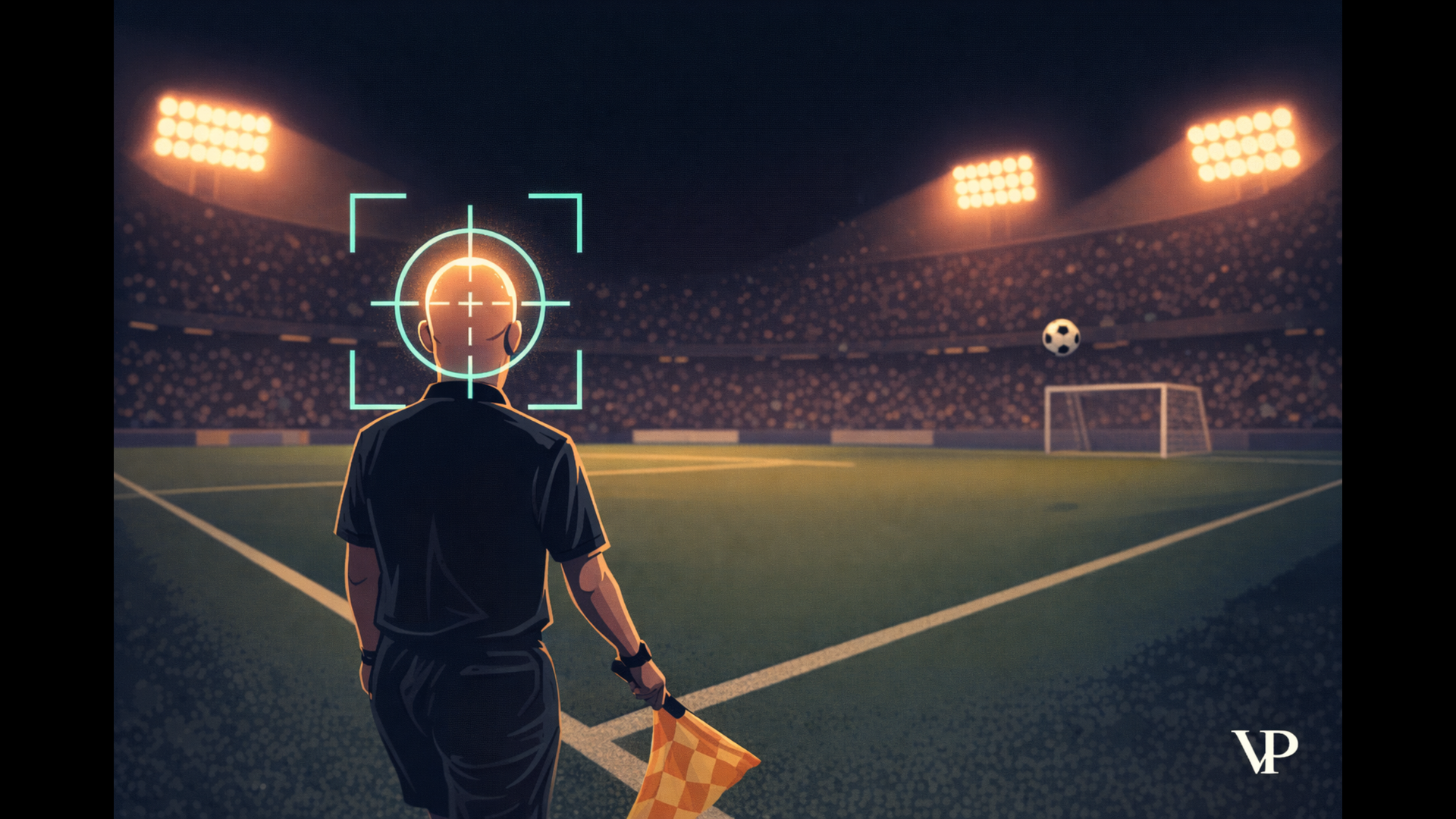
In October 2020, fans tuning into a Scottish soccer match between Inverness Caledonian Thistle and Ayr United saw something bizarre. The AI-powered broadcast camera — designed to autonomously track the ball — kept zooming in on the linesman's bald head. Goals were scored off-screen. The broadcast was unwatchable.
It was hilarious. It was also a perfect demonstration of why physics-constrained AI matters for every industry that depends on computer vision, from semiconductor fabs to autonomous vehicles. The camera's AI had been trained to find round, light-colored objects. Under stadium floodlights, a shiny bald head and a soccer ball looked identical — at least to an algorithm that only understands pixels, not physics.
The system didn't malfunction. It performed exactly as designed. That's the problem.
Your AI Sees Textures, Not Reality
The broadcast system used a standard object detection model — the same family of deep learning architectures that powers most commercial computer vision today. These models decompose images into patterns: edges, curves, textures, gradients. They're remarkably good at finding things that look like what they've been trained on.
But "looks like" and "is" are dangerously different concepts.
A human viewer instantly knows a bald head isn't a soccer ball. Not because of what it looks like, but because of how it behaves. A soccer ball moves at up to 80 mph in unpredictable arcs shaped by gravity. A head stays attached to a body, moves at walking pace, and hovers at a constant height of about 5.5 feet. The AI couldn't make this distinction because it had no concept of motion, gravity, or physical objects. It processed each video frame as an isolated photograph — a frozen moment with no memory of what came before and no expectation of what comes next.
We call this frame-independent inference, and it's the default mode for most off-the-shelf computer vision APIs. The system analyzes Frame 1, finds a "ball," then forgets everything and starts fresh on Frame 2. If a shinier candidate appears — say, a head catching the light — the system jumps to it without hesitation, because nothing in its architecture says "a ball can't teleport 15 meters between frames."
The Bald Head Problem Is Everywhere
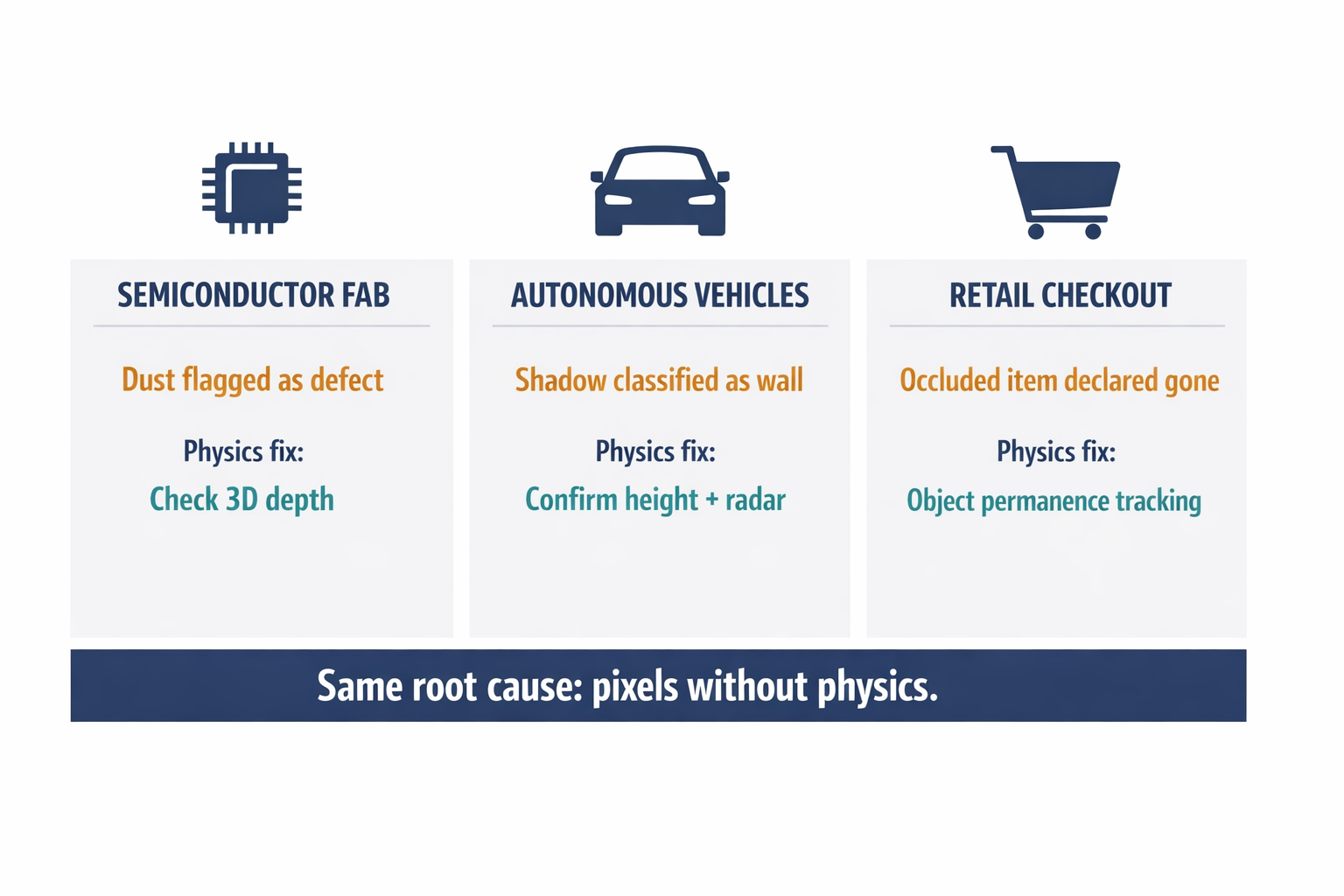
This isn't a sports curiosity. The same failure pattern costs real money — and poses real danger — across industries.
In semiconductor manufacturing, automated inspection systems flag dust particles as circuit-killing defects. The particle looks like a defect. But a physics-aware system would check whether the anomaly has three-dimensional depth (a real defect) or sits flat on the surface (harmless dust). Industry research suggests that improving defect detection accuracy by just 1% can increase yield by 5–10%, saving millions annually.
In autonomous vehicles, the phenomenon is called "phantom braking." A shadow falls across the highway. The vision system sees a dark band and classifies it as a wall or a stopped vehicle. The car slams on its brakes at 70 mph. A physics-constrained system would check: does this "obstacle" have any height above the road surface? Is radar confirming a solid object? If the answer is no on both counts, the brakes stay off.
In retail, "just walk out" checkout systems lose track of items when a customer's hand briefly obscures the product. The object disappears from view, and the AI declares it gone — because it has no concept that objects continue to exist when you can't see them. Developmental psychologists call this "object permanence." Most toddlers master it by age two. Most commercial AI hasn't.
Generic AI reaches 90% accuracy fast and cheap. But the business value — and the business risk — lives entirely in the last 10%.
How Physics Fixes What More Data Can't
The conventional response to AI failures is "more training data." Collect more images of bald heads labeled "not ball." Collect more images of shadows labeled "not wall." This approach works — until the next edge case arrives that wasn't in the training set.
Our approach is fundamentally different. Instead of trying to enumerate every possible failure, we give the AI an understanding of how the physical world works. We treat the output of a neural network not as a fact, but as a hypothesis that must survive a physics test.
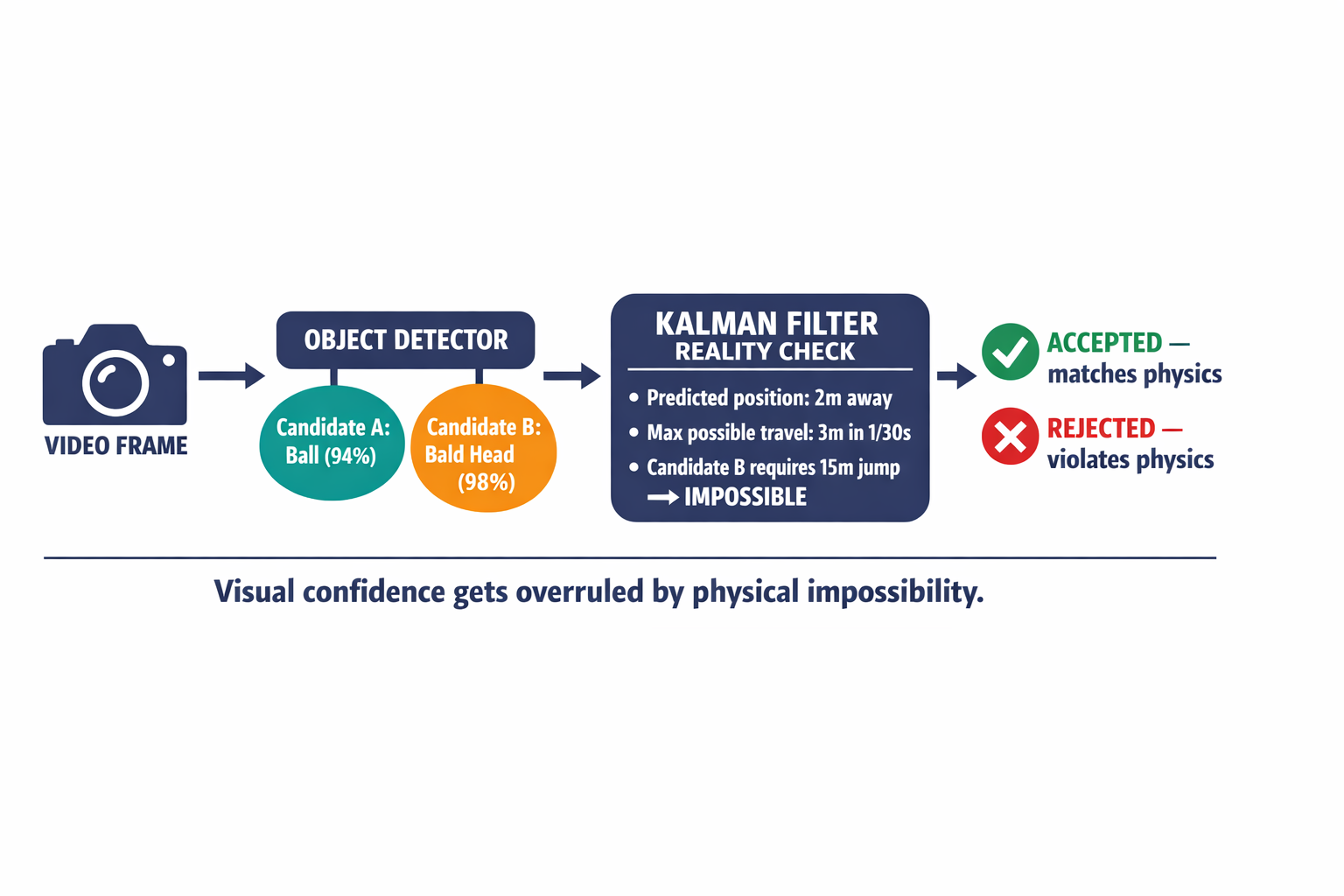
The core idea is straightforward: run your standard object detector, let it generate candidates, then pass every candidate through a series of physical reality checks before accepting it.
We explored this approach in depth in our interactive analysis of physics-constrained enterprise AI, but the key mechanism is worth explaining here.
The workhorse is something called a Kalman Filter — a mathematical tool originally developed for aerospace navigation in the 1960s. It maintains a running estimate of where an object is, how fast it's moving, and how certain it is about both. Before the vision system even processes the next frame, the Kalman Filter predicts where the object should be, based on its previous trajectory and basic Newtonian physics.
When the vision model returns its candidates, the filter compares each one against its prediction. If Candidate A appears roughly where physics says the ball should be, it's accepted. If Candidate B — the bald head — appears 15 meters away from the predicted position, the filter calculates whether any soccer ball could physically travel that distance in one-thirtieth of a second. It can't. The candidate is rejected, regardless of how confident the vision model is about the texture match.
This is the critical insight: visual confidence gets overruled by physical impossibility. A 98% confidence score means nothing if the detection requires the ball to have accelerated faster than a bullet.
When the Ball Disappears
The Kalman Filter solves another problem that plagues generic vision systems: what happens when the object you're tracking vanishes behind something.
In a soccer match, a player runs between the camera and the ball. For a few frames, the ball is invisible. A standard system panics — confidence drops to zero, the tracker resets, and when the ball reappears, the system might latch onto the nearest round object (our friend the linesman's head, perhaps).
A physics-constrained system handles this gracefully. The ball was moving at 20 meters per second before it disappeared. Physics says it's still moving at roughly 20 meters per second (minus a bit of air resistance). The filter "coasts" — maintaining its estimate of the ball's position based on predicted trajectory, even with no visual input. When the ball emerges from behind the player, the system knows exactly where to look.
This isn't a trick. It's how every missile guidance system and spacecraft navigation computer has worked for decades. We're applying the same mathematical rigor to problems that the tech industry has been trying to solve with brute-force pattern matching alone.
Beyond Trajectory: Teaching Neural Networks the Laws of Physics
For environments more complex than a ball in flight — fluid dynamics in industrial pipes, the curved path of a spinning ball subject to aerodynamic forces, robotic arm manipulation — simple Newtonian filtering isn't enough. This is where Physics-Informed Neural Networks (PINNs) come in.
A standard neural network learns by minimizing the gap between its predictions and labeled training data. If the training data is noisy or sparse, the network can learn to predict physically impossible things — a ball that changes direction mid-air with no force acting on it, a fluid that flows uphill.
PINNs add a second penalty: the network is also punished for violating the governing equations of physics. If the model predicts a trajectory that breaks conservation of energy, that prediction gets penalized during training, even if it happens to match a noisy data point.
The practical result is striking. A PINN needs far less training data than a conventional model because physics eliminates most of the impossible solution space before training even begins. It also generalizes better to situations it's never seen, because it understands the rules — not just the examples.
For the full technical methodology behind our physics-constrained architecture — including how we implement optical flow constraints and Hamiltonian Neural Networks for energy-conserving systems — see our detailed research.
The 90% Trap: Why "Good Enough" AI Is Expensive
Enterprise leaders face a familiar choice: buy an off-the-shelf computer vision API or build something custom. The API gets you to 90% accuracy in weeks. It's cheap. It's easy.
But that last 10% is where the edge cases live — and edge cases are where the money is.
In sports broadcasting, the edge case is a bald head that costs you subscribers.
In chip manufacturing, it's a false defect flag that scraps a $10,000 wafer.
In autonomous driving, it's a phantom brake event that causes a highway pileup.
The off-the-shelf API has no mechanism to handle these cases because it has no understanding of the physical domain. Adding a physics layer doesn't just improve accuracy marginally — it changes the failure mode entirely. Instead of confidently wrong answers, you get systems that know when they're uncertain and default to physical plausibility.
Object detection is not object understanding. Pixels tell you what something looks like. Physics tells you what something is.
The total cost picture shifts accordingly. A physics-constrained system costs more upfront — it requires domain-specific engineering. But it eliminates the ongoing costs of human review for false positives, scrapped product, liability exposure, and the reputational damage of systems that fail in embarrassing or dangerous ways. And critically, you own the intellectual property. You're not renting someone else's general-purpose model and hoping it works for your specific physics.
What If Your Inspection System Doesn't Know About Gravity?
If you're deploying computer vision in any environment where objects move, have physical properties, or exist in three dimensions — which is to say, the real world — it's worth asking a pointed question: does your AI know anything about physics?
Most don't. Most process the world as a flat collection of textures, with no concept of momentum, gravity, depth, or object permanence. They work beautifully in controlled conditions and fail unpredictably at the edges.
The Scottish soccer incident was funny because the stakes were low. Nobody got hurt. But the same architectural flaw — visual confidence without physical reasoning — is running in factories, on highways, and in operating rooms right now.
We've spent years building systems that treat physics as a first-class constraint rather than an afterthought. The math isn't new — Kalman Filters date to the Apollo program. What's new is the recognition that enterprise AI needs this layer, and that bolting it on after deployment is far harder than designing it in from the start.
If your team is wrestling with false positives, phantom detections, or tracking failures in production vision systems, we'd be curious to hear what you're seeing. The bald head problem takes different forms in every industry — but the underlying cause is almost always the same.