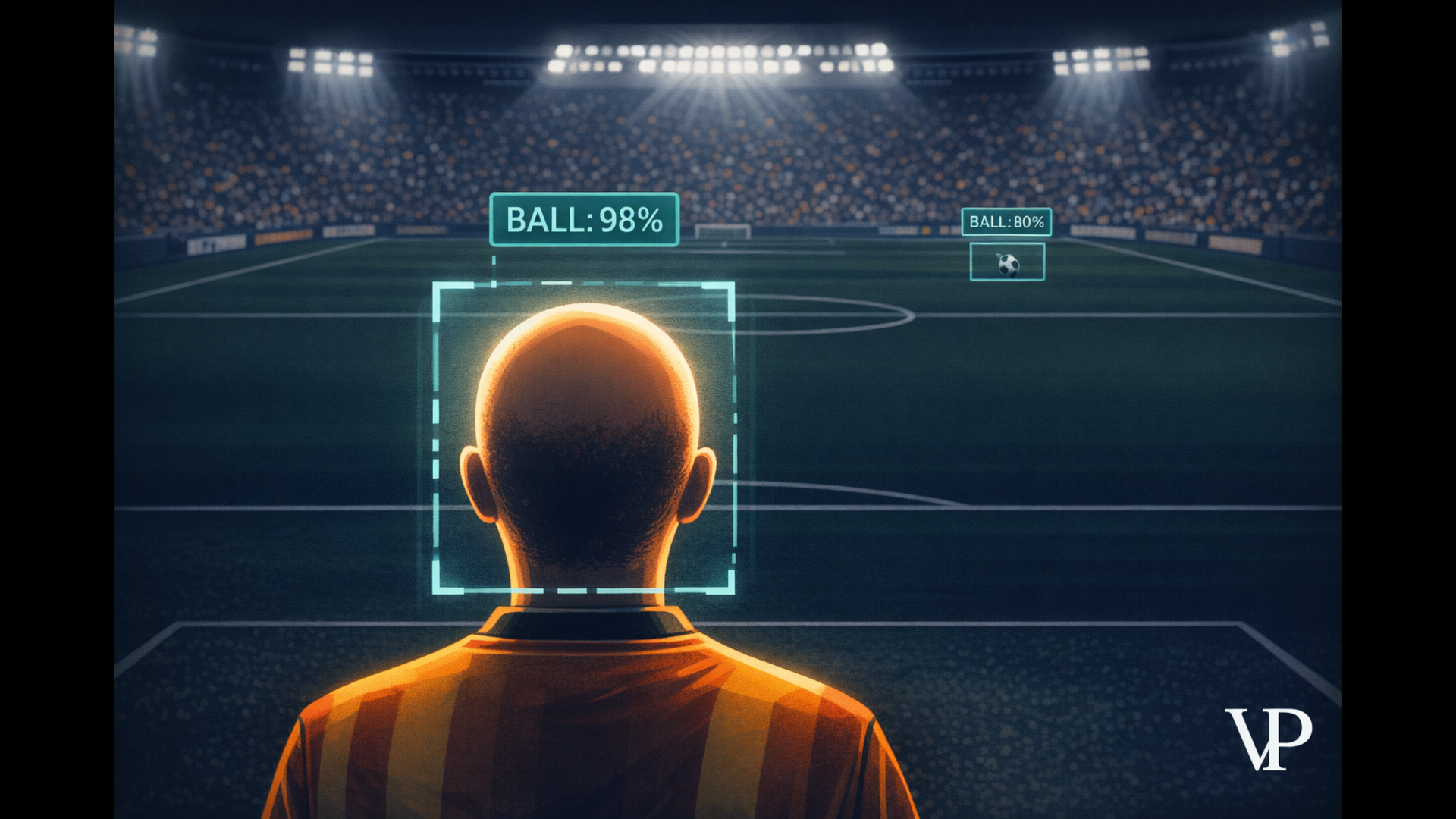
In October 2020, fans tuning into a Scottish soccer match between Inverness Caledonian Thistle and Ayr United watched something bizarre. The AI-powered camera — designed to automatically follow the ball — kept zooming in on the linesman's bald head. Goals were scored off-screen. The broadcast was unwatchable.
Most people laughed. I couldn't stop thinking about it.
That camera system wasn't stupid. It was doing exactly what it was built to do: find the round, light-colored object with the highest confidence score. Under stadium floodlights, the linesman's head — shiny, spherical, well-lit — scored a 98% match for "ball." The actual ball, blurred by speed and darting through shadows, might have scored 80%. The AI followed the math. The math was wrong.
This isn't a sports blooper. It's a physics-constrained AI problem, and the same failure mode is quietly costing manufacturers millions, causing autonomous vehicles to slam their brakes at shadows, and making checkout-free retail stores accuse shoppers of theft.
The Real Problem: Detection Without Understanding
The soccer camera could detect a round object. What it couldn't do was understand what a ball is.
A human — even a child — instantly knows the difference between a head and a ball. Not because of what they look like, but because of how they behave. A ball flies in arcs shaped by gravity. It accelerates when kicked. It bounces. It is not attached to a person's neck.
The AI had none of this context. It processed each video frame as a standalone photograph, identifying shapes and textures with no memory of what happened a fraction of a second earlier. It had no concept of gravity, no model of how fast a soccer ball can travel, no understanding that an object moving at walking pace at a constant height of 5.5 feet is almost certainly a human, not a projectile.
Object detection is not object understanding. That gap is where enterprise AI fails.
I started calling this the "bald head problem" — and once you see it, you see it everywhere.
This Isn't Just About Soccer
The same architectural flaw — relying on visual probability while ignoring physical possibility — shows up across industries with far higher stakes than a missed goal.
In semiconductor manufacturing, automated inspection systems flag harmless dust particles as fatal circuit defects. The visual pattern matches, so the AI raises the alarm. The result: perfectly good silicon wafers get scrapped or routed to expensive human review. Industry data suggests that improving defect detection accuracy by just 1% can boost yield by 5–10%, saving millions annually.
In autonomous vehicles, the phenomenon has a name: "phantom braking." A shadow falls across the highway. The vision system sees a dark band and classifies it as a wall or stopped vehicle. The car slams on its brakes at 70 mph. Passengers lurch forward. The car behind nearly rear-ends you.
In cashierless retail, a customer drops an item into their bag. Their hand briefly blocks the camera's view. The system loses track of the product — it literally stops believing the item exists — leading to either a missed charge or a false theft accusation.
Every one of these failures has the same root cause: the AI sees textures, not physics.
Why "Just Add More Data" Doesn't Fix This
The instinctive response from most AI teams is to retrain with more examples. Show the model a thousand bald heads labeled "not ball." Show it a thousand shadows labeled "not obstacle."
I spent enough time down this path to know it's a dead end for edge cases. You can't train your way out of every weird lighting condition, every unusual angle, every rare scenario. The physical world is too variable. What you can do is give the AI something humans take for granted: an understanding of how objects actually move.
That realization reshaped how my team builds vision systems. We explored the full technical reasoning in our interactive analysis, but the core idea is simple enough to explain over coffee.
Teaching AI the Laws of Physics
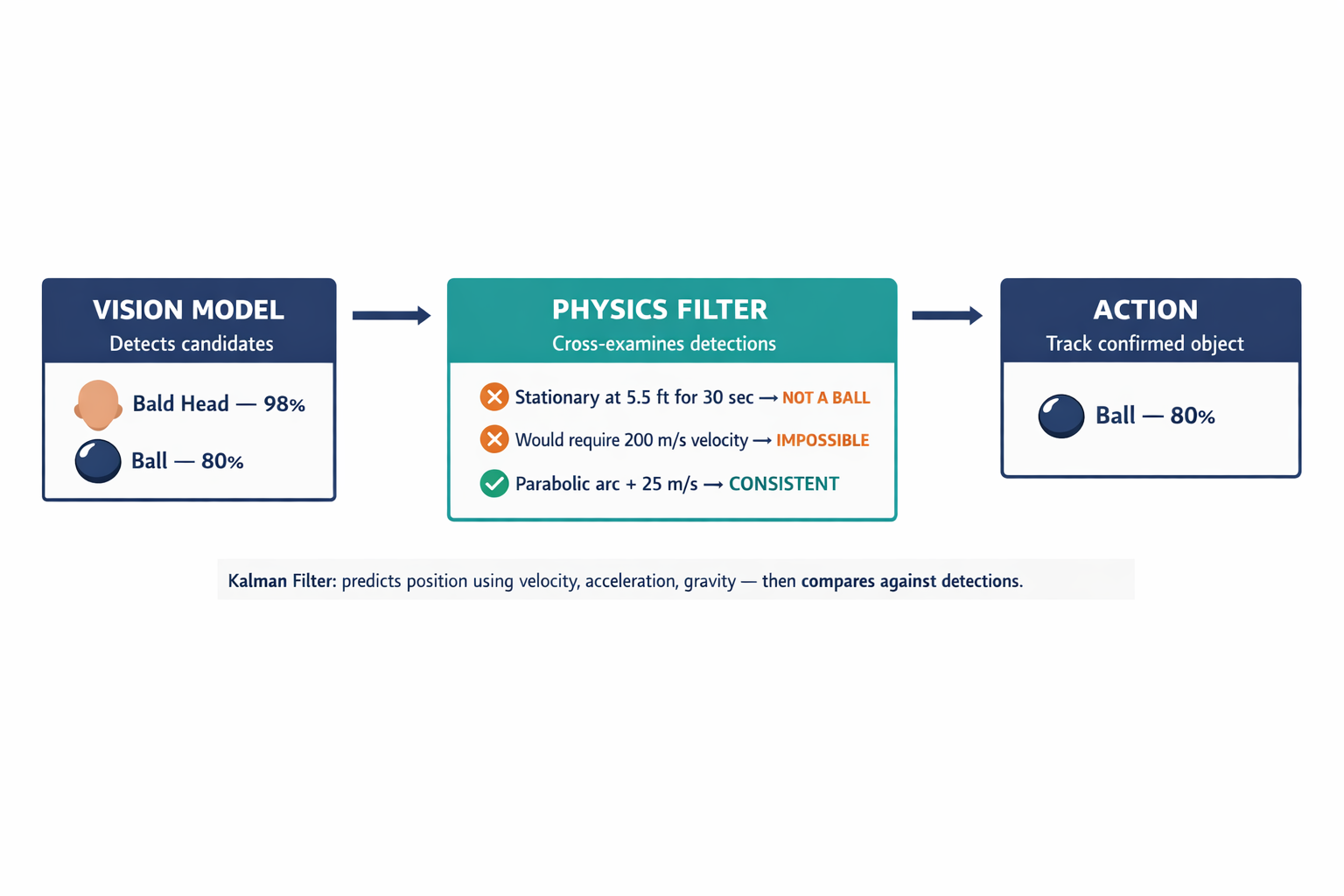
The approach we've built around — physics-constrained vision — treats every AI detection not as a fact, but as a hypothesis that must pass a physics test before the system acts on it.
Think of it like a courtroom. The neural network is the witness: "I saw a ball at these coordinates." But before the verdict is delivered, the testimony gets cross-examined by physics. Did the "ball" teleport 15 meters in one-thirtieth of a second? Physically impossible — testimony rejected. Is the "ball" hovering at the same height for minutes? That's not how gravity works — testimony rejected.
The mechanism behind this is a technique called a Kalman Filter, which has been used in aerospace and missile guidance for decades. It maintains a running estimate of where an object is, how fast it's moving, and how uncertain those estimates are. Before the camera even processes the next frame, the filter predicts where the ball should be based on Newtonian mechanics — velocity, acceleration, gravity.
When the vision system returns its candidates, the filter compares them against its prediction. If a candidate is wildly inconsistent — like a "ball" that would need to accelerate faster than any kick in soccer history to reach its reported position — the filter rejects it, no matter how confident the visual model is.
The system doesn't just ask "what does this look like?" It asks "is this physically possible?"
The beauty of this approach is what happens during occlusion — when a player runs between the camera and the ball. A standard vision system panics: the ball vanished, confidence drops to zero, tracking fails. A physics-constrained system stays calm. It knows the ball didn't stop existing. It predicts the ball's position behind the obstruction based on its last known trajectory and waits for it to reappear. Object permanence — something human infants develop by eight months old — finally available to AI.
Where It Gets Interesting: The Physics Loss Function
For straightforward scenarios — a ball in flight, a car on a highway — Kalman Filters and motion analysis handle the physics layer well. But some environments are more complex. A soccer ball with heavy spin curves through the air in ways that simple projectile equations don't capture. Fluid dynamics in industrial pipes follow turbulent patterns. Robotic arms need to conserve energy over long operation windows.
For these cases, my team works with Physics-Informed Neural Networks, or PINNs. The concept is elegant: during training, the network gets penalized not just for wrong answers, but for physically impossible answers.
A standard neural network minimizes one thing: the gap between its predictions and the labeled training data. A PINN adds a second penalty — the degree to which its predictions violate the governing physical equations. If the network predicts a ball curving mid-air with no force acting on it, that violates Newton's laws, and the penalty spikes.
The practical result surprised me. These networks need far less training data than conventional models because physics eliminates most of the impossible solutions from the search space. The network isn't memorizing patterns from thousands of examples; it's learning the rules that generate those patterns. It generalizes to scenarios it has never seen because the laws of physics don't change.
For the detailed mathematical framework — including how we use Hamiltonian Neural Networks for energy-conserving systems and Lagrange multipliers for hard constraints — see our full technical deep-dive.
The 90% Trap
I talk to enterprise leaders every week who are evaluating AI for inspection, tracking, or automation. Almost all of them start with the same approach: plug in a cloud vision API, get to 90% accuracy fast and cheap, declare victory.
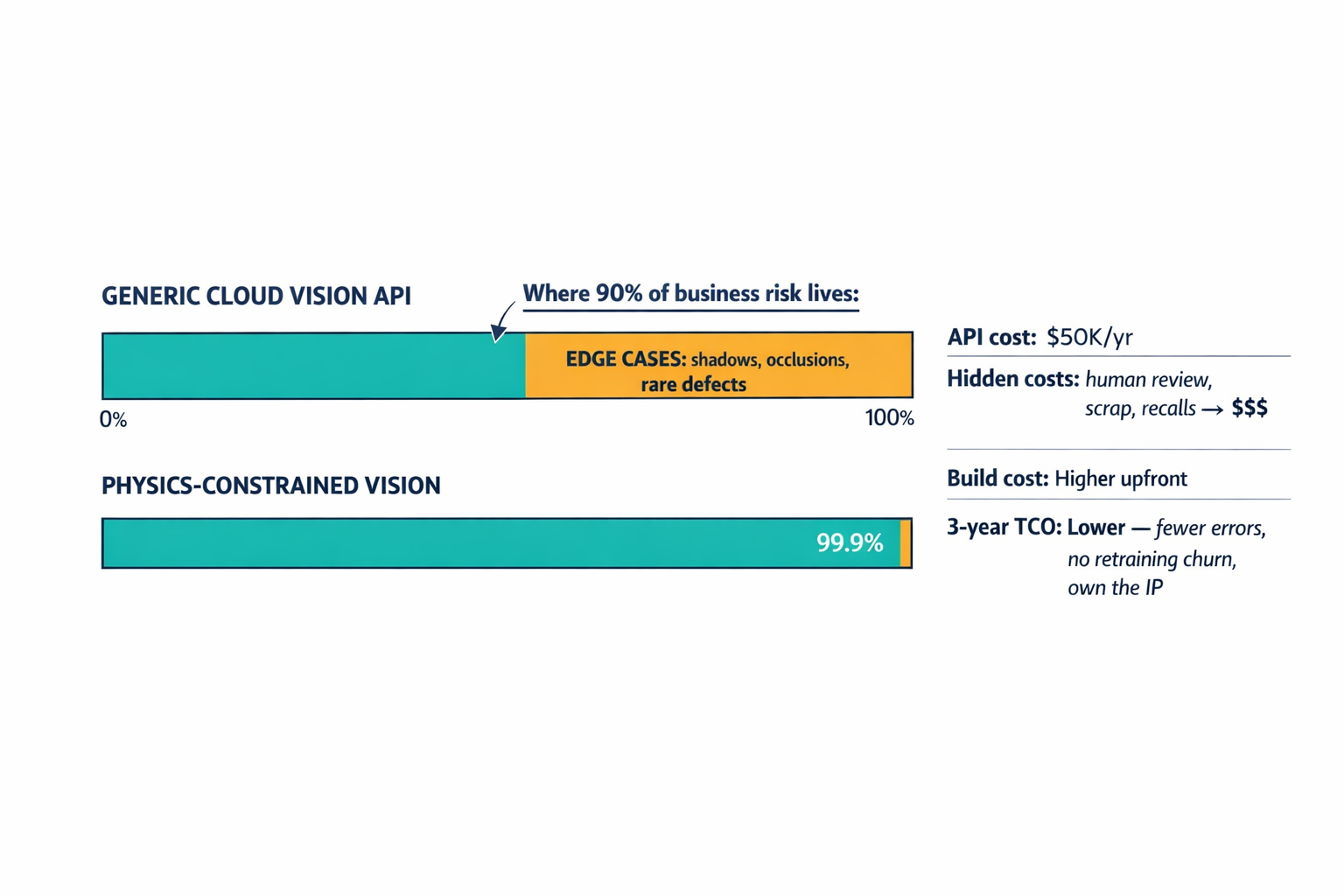
Ninety percent sounds great until you realize where the remaining 10% lives. It's the edge cases. The unusual lighting. The rare defect. The shadow on the highway. And that last 10% is where virtually all the business risk concentrates.
In semiconductor fabrication, the standard defects are easy — any off-the-shelf model catches them. The ones that destroy yield are the subtle, ambiguous anomalies that look like noise to a generic classifier. In autonomous driving, 90% of the road is straightforward. The 10% that kills people is the unusual stuff: a motorcycle half-hidden behind a truck, a pedestrian in dark clothing at dusk, a plastic bag blowing across the lane.
Generic AI gets you to 90% accuracy. Physics gets you from 90% to 99.99%. That last gap is where the money — and the risk — lives.
The economics shift dramatically when you factor in the cost of errors. A wrapper API might cost $50,000 a year in subscription fees. But if its false positives require a team of human reviewers to catch, or if its misses result in scrapped product, recalls, or liability — the total cost dwarfs the subscription.
A physics-constrained system costs more to build upfront. But it filters out false positives before they reach a human, maintains tracking through occlusions without losing objects, and doesn't require constant retraining every time the lighting changes. Over a three-year window, the total cost of ownership is almost always lower for mission-critical applications — and you own the IP.
What About Simpler Environments?
Fair question. If your factory floor has controlled lighting, a fixed camera angle, and objects that don't move fast, you may not need physics constraints. A well-tuned conventional model might be sufficient.
But I'd push back gently: "controlled" environments are less controlled than people think. Lighting shifts over the course of a day. Machines vibrate and change camera alignment by fractions of a degree. New product variants introduce visual patterns the model hasn't seen. The edge cases accumulate, and each one is a potential false positive or missed defect.
Physics constraints aren't just about handling chaos. They're about making the system robust to the slow drift of reality away from the conditions it was trained on.
Does This Scale?
The other objection I hear: "This sounds computationally expensive." It's the opposite. Kalman Filters are among the most efficient algorithms in all of engineering — they were designed to run on 1960s spacecraft computers. Optical flow analysis adds modest compute. Even PINNs, because they converge faster with less data, often train quicker than brute-force deep learning models that need millions of labeled examples.
The heaviest lift is the engineering upfront: understanding the physics of your specific domain, selecting the right constraints, and integrating them into the inference pipeline. That's the hard work. But once built, these systems are remarkably efficient to run.
What I Keep Coming Back To
There's a moment from the Inverness match that I think about often. The camera locked onto the linesman's head, and somewhere in the system's logic, it was confident. Ninety-eight percent confident it was looking at the ball. It had never been more certain — and it had never been more wrong.
That's the failure mode of AI systems that know everything about pixels and nothing about physics. They don't fail gracefully. They fail with supreme confidence.
The next generation of enterprise AI won't be defined by bigger models or more parameters. It'll be defined by whether the system understands the world it's operating in — whether it knows that balls fall, cars can't stop instantly, and objects don't vanish when you blink.
I'd be curious to hear from anyone wrestling with false positives in industrial vision or inspection. What's your "bald head" problem?