A UPS setting can reduce unnecessary transfers to backup while also making a developing fault harder to detect. For a facilities leader, those outcomes belong in the same decision. Keeping IT equipment powered on backup and keeping its load on the utility grid are different objectives.
I want an AI-assisted recommendation to carry an explicit withdrawal rule. A persuasive explanation should not keep a setting in circulation after the tests that support it have changed. Our Veriprajna Data Center Grid Interaction demo makes that decision visible in a synthetic facility simulation.
The candidate only passes the tests it has faced
The simulation searches combinations of disturbance-counting settings for an uninterruptible power supply, or UPS, fleet. Each counted voltage dip adds a strike. Enough strikes within a rolling time window trigger a transfer to backup. A separate deep-sag condition can also trigger transfer, independently of that counter.
Acceptance has two requirements: avoid a counting-driven cascade across the finite benign-event library, and transfer every modeled unit across the tested fault library by each event's configured test deadline. That deadline is a simulator rule, not a validated electrical withstand limit.
In the recorded synthetic Ashburn case, the initial library supports a candidate with five strikes in a 90-second rolling window, using aggregate counting. That is a preliminary result. The workflow then adds a challenge and checks the settings again.
The model-assisted part uses previously cached replies through a local bridge. It does not demonstrate fresh inference or Cloudflare-hosted inference. Its role here is to propose an additional event; deterministic code decides whether a candidate satisfies the tests.
How the added test changes the decision
The proposed event is named "Progressive transformer-winding insulation fault." It contains four counted dips spaced more than 90 seconds apart. For the preliminary candidate, earlier strikes leave the rolling window before enough can accumulate. The counter never reaches five.
The dips also remain above the separate deep-sag transfer threshold of 0.60 per unit, where 1.0 represents nominal voltage. Neither transfer path catches the proposed event under that candidate. The name describes a synthetic test scenario, not an independently established transformer diagnosis.
The second pass evaluates the same 32 counting combinations against the four base faults plus this additional proposed fault, while retaining the benign-event requirement. No combination passes both requirements. The final result is abstain, with no selected configuration. The preliminary recommendation is withdrawn.
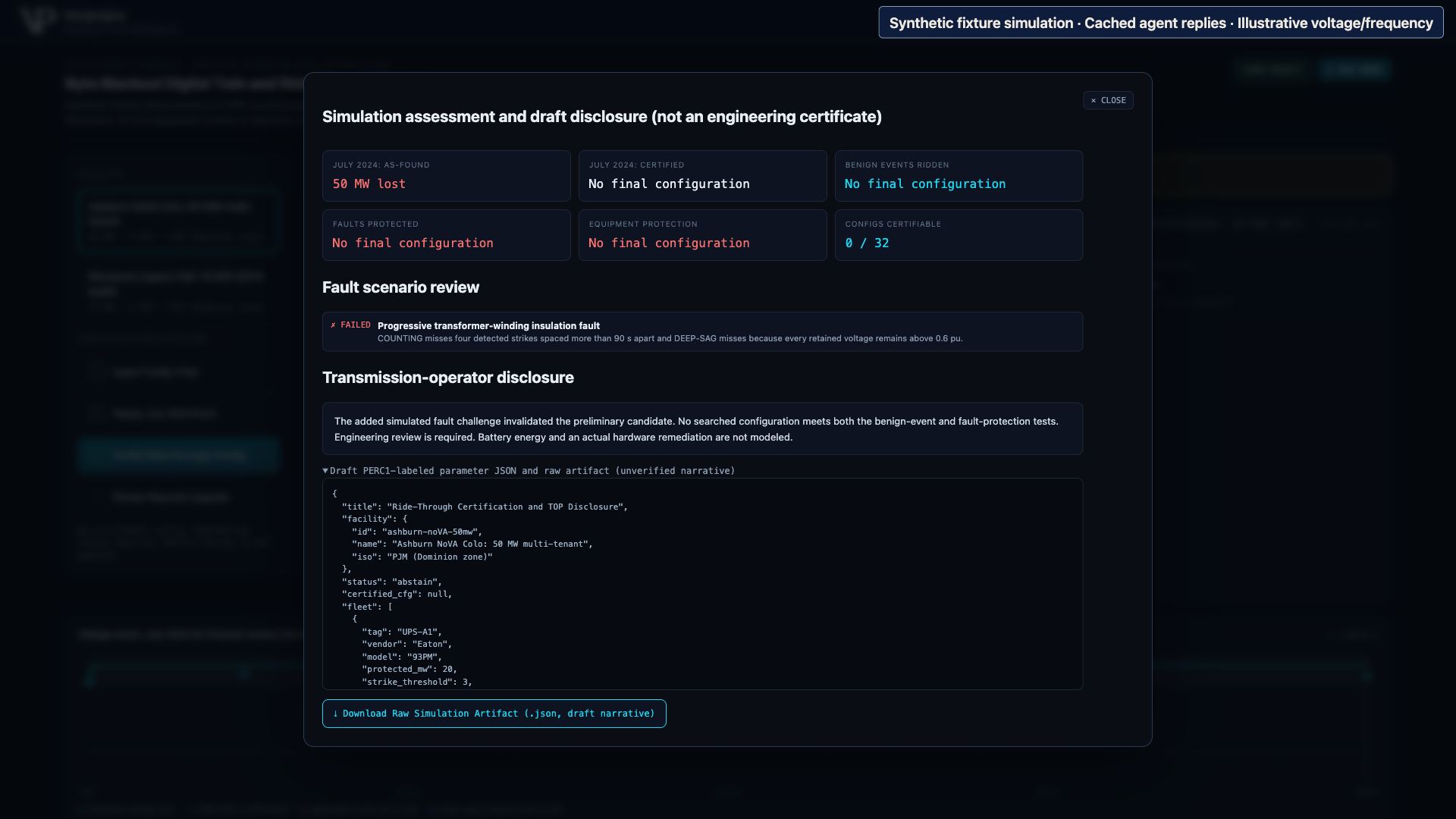 The cached model-assisted synthetic run ends with no final configuration. The visible fault review explains why the preliminary candidate fails; the disclosure and downloaded narrative remain draft simulation output, not an engineering certificate.
This result says something precise: no setting in the searched set satisfies this test library. It does not establish that every possible setting fails, that the scenario is a physically validated fault, or that the facility needs a particular hardware repair.
What should leave the workflow
If a recommendation has already reached an engineering reviewer, adding the fault cannot merely append a warning to the old settings. The decision record should identify the earlier candidate as superseded, retain the added scenario and failed transfer check, and show that the renewed search produced no replacement. Otherwise, someone reading only the configuration could act on evidence that no longer supports it.
That is the design standard I take from this example: a challenge should be able to change what the workflow recommends, including removing the recommendation entirely. Keeping the earlier candidate available as an approved answer would defeat the second pass.
The refusal still leaves engineering work to do. A real settings decision needs verified equipment parameters, measured disturbances, an appropriate validated electrical model and independent engineering review. This demo does not model battery energy or transfer latency, and it does not authorize changes to equipment.
The demo breakdown shows the simulation and its limits. For the reviewer receiving an abstention, the next task is to establish which assumptions and test cases deserve validation before another configuration can be proposed. A clear refusal preserves that unfinished work.