A data center can keep its IT equipment powered while transferring its load away from the utility grid. Those are different outcomes. A setting that reduces transfers during brief voltage disturbances can help the modeled facility remain connected, but that same setting still needs to trigger a transfer when a tested fault calls for one.
For facilities leaders and their utility planning counterparts, the useful engineering question is therefore two-sided: which disturbances should the equipment ride through, and which should make it leave the grid? Optimizing only for continued connection leaves the second half unanswered.
In our synthetic data-center UPS simulation, a preliminary configuration passes its first set of checks. An additional model-proposed fault then invalidates it. The final search finds no acceptable candidate, and the system withdraws the recommendation. That refusal is the result worth examining.
Acceptance depends on both behaviors
A UPS, or uninterruptible power supply, can use a rolling counter to register voltage disturbances. In this demo, enough counted disturbances within a configured window trigger a transfer to backup. A separate deep-sag path handles sufficiently low voltage sustained for the modeled duration. Changing the counter does not change that separate path.
We evaluate counting settings against two finite event libraries. The benign library tests whether the synthetic fleet avoids a counting-driven transfer during the events it is meant to ride through. The fault library tests whether every unit transfers by the configured event-relative test deadline. A candidate must pass both conditions. Better performance on one cannot compensate for failure on the other.
This matters because a setting can appear attractive when the only question is whether it keeps load on the grid. Raising a strike threshold gives repeated disturbances more room before a transfer. But the same change can make a developing fault harder for the counter to catch. The acceptance rule has to preserve the reason for leaving as well as the reason for staying.
The example uses a synthetic 50 MW facility with three fixture UPS units. Its data, vendor-style exports and voltage events are illustrative. The simulator uses the canonical fixture fleet; the displayed extraction of vendor-style records does not make this a test of arbitrary uploaded equipment data.
The added fault changes the decision
The recorded model-assisted run uses previously cached model replies through a local bridge. It shows no fresh inference. Its initial search identifies a preliminary candidate: five strikes in a 90-second window, using aggregate counting.
The cached challenger reply proposes an additional simulated event, labeled a progressive transformer-winding insulation fault. It contains four counted dips spaced more than 90 seconds apart. Each dip remains above the separate deep-sag threshold of 0.60 per unit, or 60 percent of nominal voltage.
For the preliminary candidate, the spacing keeps earlier strikes outside the rolling window. The sequence never reaches its five-strike trigger. The dips also remain too shallow for the deep-sag path. The proposed event therefore exposes a gap in both modeled transfer paths for that candidate.
The label does not establish an actual transformer fault or a hardware diagnosis. Its role here is a simulator test case. What makes it consequential is the explicit mismatch between the required transfer and the behavior produced by the proposed settings.
The deterministic second pass adds that event to the four base fault tests and searches the same 32 counting configurations. None meets both the benign-event and fault-event requirements. The final status is abstain, with no selected configuration.
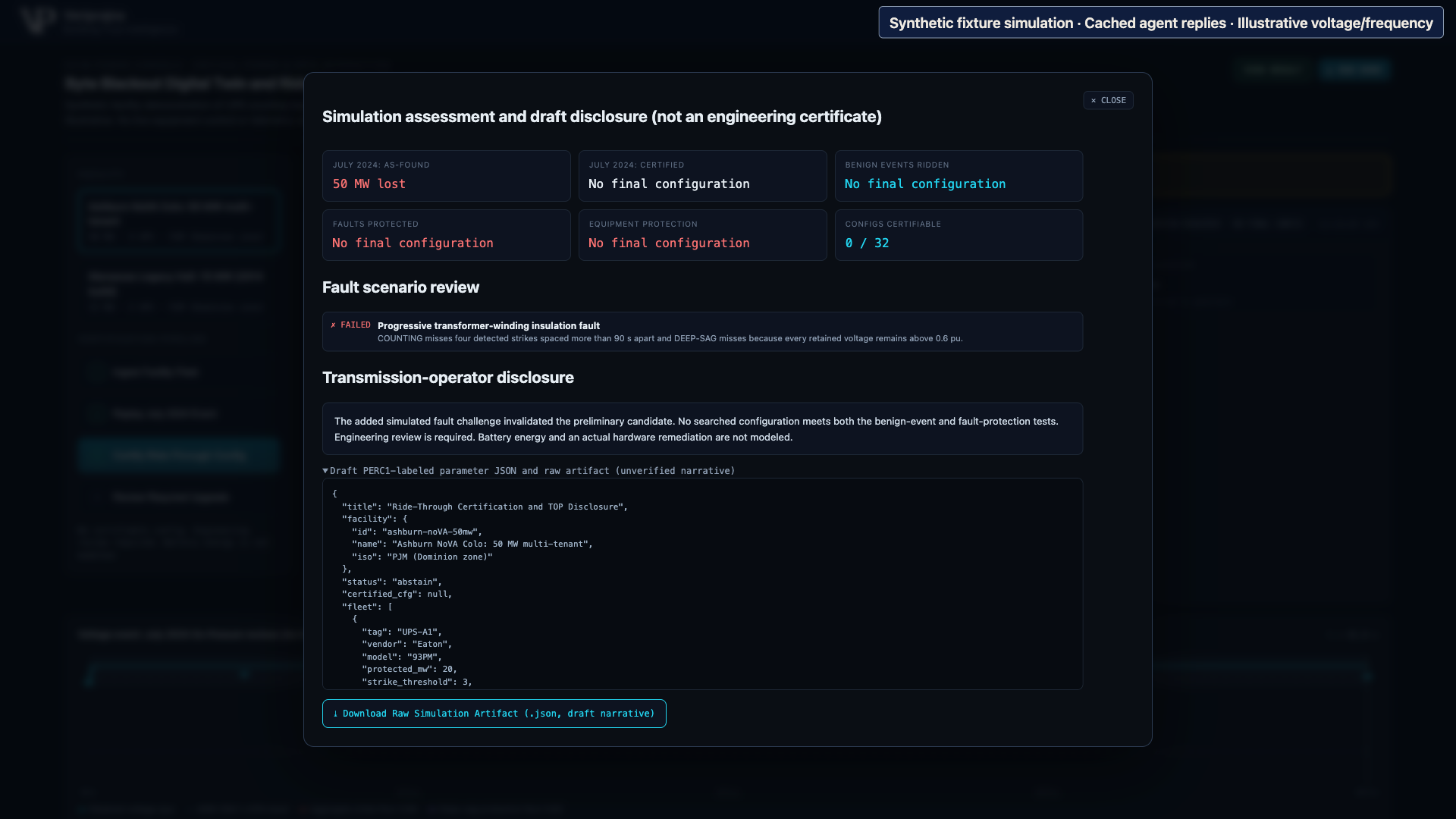 The cached model-assisted simulation withdraws its preliminary candidate. The qualified report shows no final configuration and 0/32 acceptable candidates; its disclosure and raw JSON remain draft engineering-review material.
There is no favorable replay under a final configuration in this run. Nor does zero passing candidates mean that every candidate failed every individual test. It means that none satisfied the complete acceptance rule. Report defaults for an absent configuration must not be presented as measured benign-event performance or measured retained load.
A recommendation should carry its withdrawal condition
We see a useful design standard in this example: model-assisted proposals should remain separate from the code that grants acceptance. The challenger can expand the questions asked of a configuration. It cannot declare its own proposal acceptable, and the initial passing result cannot override the later failure.
For an engineering workflow, that suggests treating a recommendation as conditional on a named test set and acceptance rule. When the test set changes, the decision must be evaluated again. Keeping the earlier recommendation because it was persuasive or already documented would detach it from the evidence that justified it.
The retained record matters for the same reason. Its structured outcome preserves the null configuration and the finite search result. That allows a reviewer to distinguish a withdrawn recommendation from a chosen setting with poor performance. The generated narrative still needs verification; a downloadable report is not automatically an engineering certificate or a filing-ready disclosure.
The full demo breakdown provides the video and explanation of this synthetic workflow. The configuration search is bounded, the voltage and frequency displays are illustrative, and the model does not validate battery energy, transfer latency or equipment condition. Applying any setting to a real facility would require verified equipment data, measured disturbances, an appropriate validated electrical model and independent engineering review.
An abstention does not identify the engineering remedy. It establishes a narrower, useful boundary: the tested counting changes do not earn a recommendation under the expanded checks. For a facilities team reviewing AI-assisted configuration advice, that is a reason to stop the settings decision and investigate the missing evidence before acting.