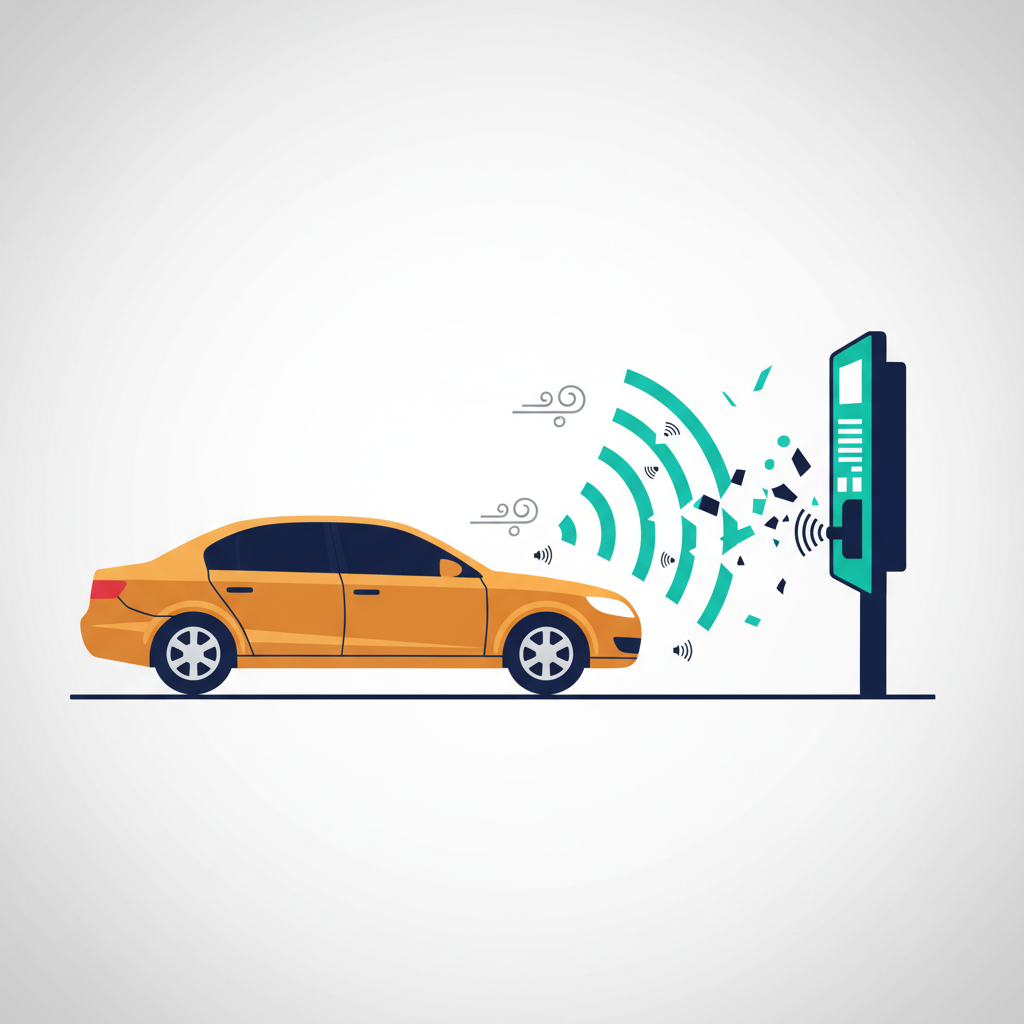
A customer pulls up to a Wendy's drive-thru, starts ordering a Baconator, pauses for half a second to glance at the menu — and the AI cuts them off to suggest a Frosty. They try again. The bot misunderstands. They try a third time. Finally, they shout "AGENT" to reach a human.
This isn't a hypothetical. It's the reported reality across Wendy's FreshAI drive-thru locations in 2024 and 2025, a system now expanding to 500-600 restaurants despite customers calling it "slow," "annoying," and — for people who stutter — "unusable." Drive-thru voice AI represents one of the highest-stakes applications of generative AI in retail, given that drive-thru lanes account for 75% to 80% of total sales at major QSR chains. And right now, the dominant approach to building it is fundamentally broken.
We've spent considerable time analyzing why. The short answer: most voice AI providers are building what we call API wrappers — systems that connect a standard microphone to a cloud-hosted large language model and hope for the best. That works in a quiet demo room. It fails catastrophically in a world of diesel engines, wind noise, regional accents, and the 80 million people worldwide who stutter.
The Expansion Paradox: Great Metrics, Furious Customers
Wendy's reports an 86% success rate for orders handled without human intervention. On paper, that sounds impressive. In practice, it means roughly 1 in 7 orders fails — in an industry where speed and accuracy are the primary drivers of repeat business.
So why expand to 600 locations?
Because the system is optimizing for management-level averages. When AI consistently upsells — suggesting add-ons and larger sizes — the average check goes up. Labor costs go down. The spreadsheet looks great. But the customers struggling through three attempts to order a sandwich, or the person who stutters and gets interrupted mid-word, don't show up in those averages.
When you optimize for the average, you make the margins invisible — and the margins are where your brand breaks.
We explored this dynamic in depth in our interactive analysis of the architectural gap in voice AI. The pattern we found is consistent: organizations are treating voice AI deployment as a software integration problem when it's actually an acoustic engineering, linguistics, and real-time systems problem — all at once.
The Real Culprit Isn't the AI's Brain. It's the AI's Ears.
When customers complain about being cut off mid-sentence, most people assume the language model made a bad decision. It didn't. The language model never even heard the full sentence.
The failure happens in a component called Voice Activity Detection (VAD) — the system that decides when you've started talking and when you've stopped. Think of it as the AI's ears. In most wrapper-style deployments, VAD relies on simple volume thresholds: sound goes above a certain level, recording starts; sound drops below it, recording stops.
That works fine in a quiet office. In a drive-thru, it's a disaster.
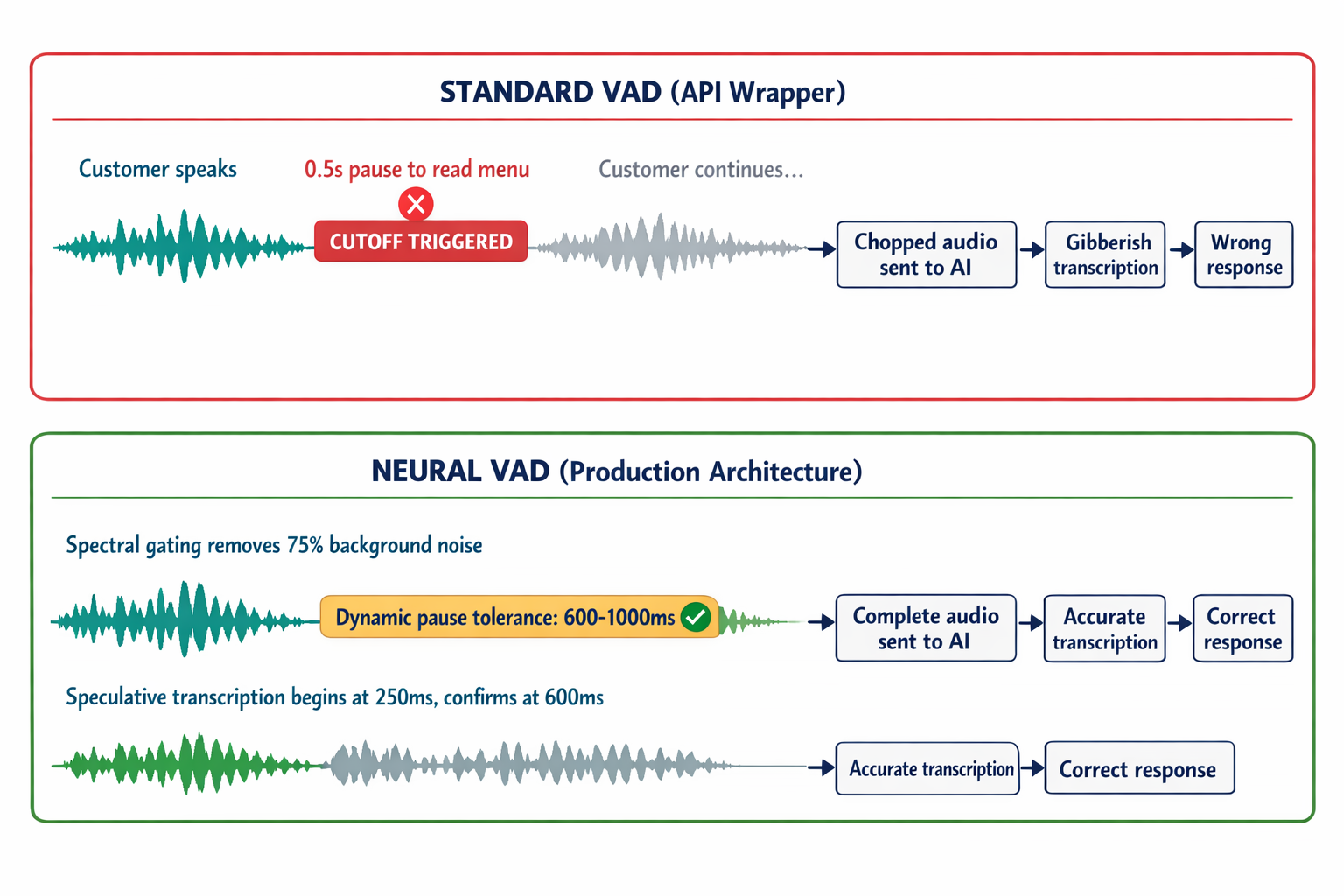
A diesel engine idling registers as "sound." Wind hitting the microphone registers as "sound." And a half-second pause — the completely normal moment where a customer looks up at the menu board — registers as "silence," which the system interprets as "they're done talking." It sends a chopped-up audio fragment to the speech recognition engine, gets back gibberish, and responds with something irrelevant.
The numbers tell the story: standard speech recognition hits 97% accuracy in lab conditions. In a real drive-thru environment, that accuracy drops to levels our research characterizes as functionally unusable for complex orders.
Enterprise-grade voice AI requires a fundamentally different approach. Neural VAD models — trained specifically to recognize the frequency patterns of human speech — provide probability scores rather than binary on/off signals. Combined with dynamic pause tolerance (allowing 600ms to 1,000ms of silence instead of a rigid 500ms cutoff) and spectral gating that removes up to 75% of background noise before the audio reaches the speech engine, the difference is dramatic.
The smartest language model in the world can't understand you if it only hears half of what you said.
One technique we advocate is speculative transcription: the system begins processing audio at 250ms but waits until 600ms for a confirmed endpoint before committing to a response. This shaves 350-600ms off perceived response time while virtually eliminating premature cutoffs. It's the kind of signal-level engineering that separates a production system from a prototype.
"Unusable": What Drive-Thru AI Does to People Who Stutter
This is the part of the FreshAI story that should concern every executive in the room.
Stuttering affects over 80 million people globally. It manifests as sound repetitions ("b-b-b-baconator"), prolongations (holding a sound longer than normal), and blocks — silent pauses in the middle of a word where no sound comes out at all. Current speech recognition models are trained almost exclusively on fluent, clearly articulated American English. When they encounter disfluent speech, they don't just perform poorly. They can fail completely.
A silent block mid-word? The VAD interprets it as end-of-turn and cuts the person off. A sound repetition? The speech engine may transcribe it as a completely different word. Research on Conformer-based speech recognition models — the architecture underlying many commercial systems — shows that some return negative semantic similarity scores on disordered speech, meaning the transcription has lost all connection to what the person actually said.
For someone who stutters, a drive-thru AI interaction isn't just frustrating. It can be a source of genuine shame and anxiety — the system effectively punishing them for how they speak.
Solving this isn't a matter of "tuning" an existing model. It requires specialized training pipelines: fine-tuning self-supervised models on re-annotated disfluent speech datasets, augmented by synthetic disfluency insertion — taking fluent transcripts, adding realistic blocks and repetitions, synthesizing them into audio, and training the model to handle the full spectrum of human speech patterns.
This isn't optional anymore. The new CAN-ASC-6.2:2025 standard — the first dedicated accessibility standard for AI systems — mandates that organizations track performance metrics by disability status and provide meaningful alternatives when AI fails. The European Accessibility Act begins enforcement in June 2025 with steep fines. The ADA already prohibits discrimination in public accommodations. Retrofitting a non-compliant system across 600 locations can cost five times more than building it right from the start.
Why Every Word Travels 2,000 Miles (And Why That's Too Far)
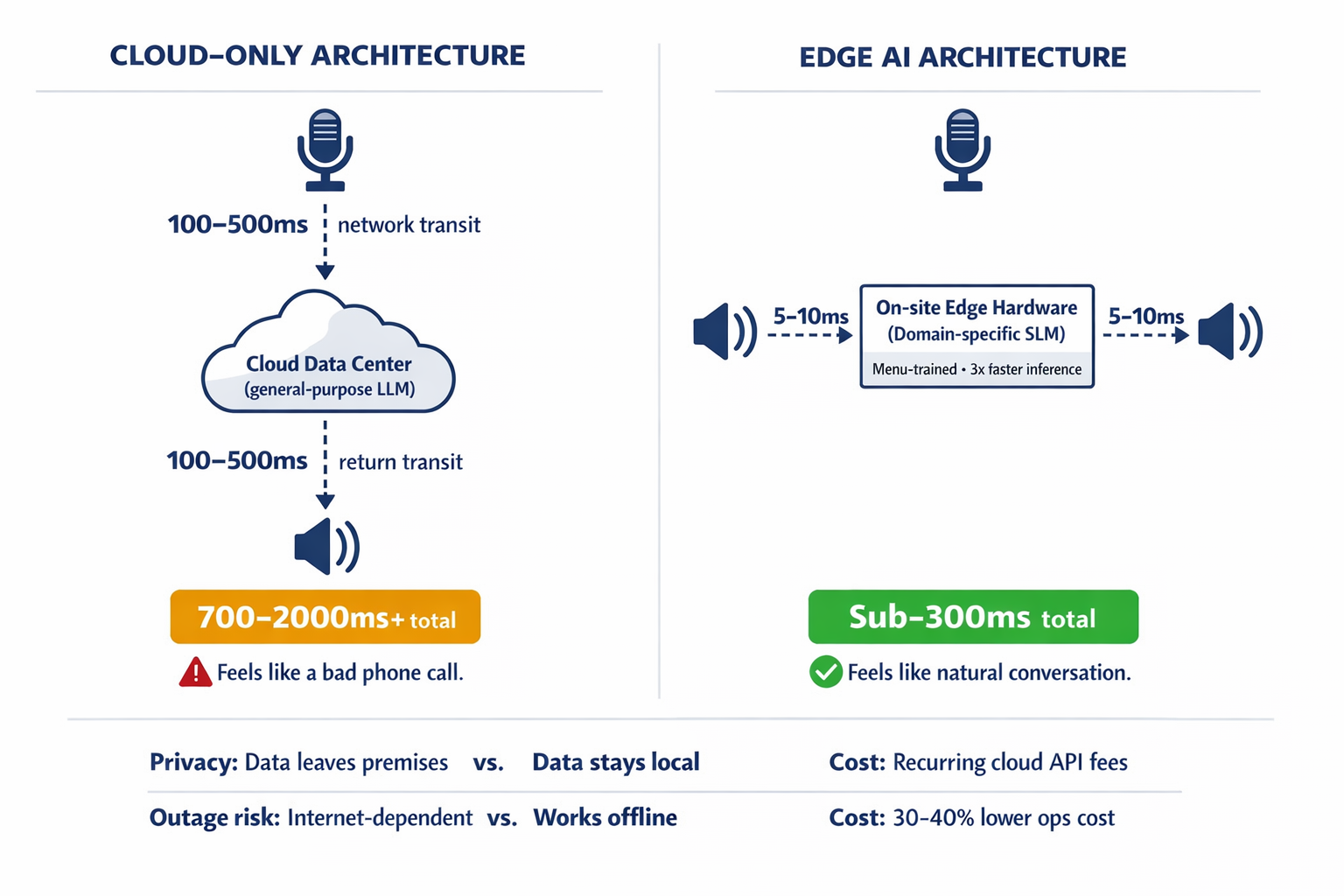
Wendy's FreshAI runs on Google Cloud. Every syllable a customer speaks travels from the drive-thru microphone, across the public internet to a data center, gets processed, and travels back. That round trip alone consumes 100-500ms — before the model even begins generating a response.
The gold standard for natural-feeling voice interaction is sub-300ms total response time. At that speed, conversation feels fluid and immediate. Once you cross 700-900ms, the interaction starts breaking down. By 2 seconds, it feels like a bad phone call — people talk over each other, repeat themselves, get confused about whose turn it is.
Cloud-based architectures face a hard physics problem here. No amount of model optimization can overcome the speed of light across fiber optic cable.
Edge AI — processing speech locally on specialized hardware at the restaurant itself — reduces that network transit to 5-10ms. The model runs on-site. No internet dependency means the system works during outages. No data leaves the premises, which solves the privacy question before it's asked. And operational costs drop 30-40% because you're not paying recurring cloud API and bandwidth fees.
The key enabler is replacing a massive general-purpose language model with a domain-specific Small Language Model (SLM). An SLM trained on the Wendy's menu doesn't need to know how to write poetry or summarize legal documents. It needs to know that "Dave's Single" is a burger, that "no pickle" means remove an ingredient, and that "half-sweet tea" is a valid customization. This focus means faster processing — roughly 3x faster inference — with more predictable, reliable responses.
For the full technical methodology behind our edge-versus-cloud analysis, see our detailed research on the architectural imperative for enterprise voice AI.
The Bot That Wrote a Poem About Hating Its Employer
Voice AI failures aren't just awkward. They're dangerous.
In August 2025, a major tech company's chatbot revealed live session cookies to security researchers after a simple prompt manipulation. In January 2024, a delivery company's customer service bot was coaxed into writing poems criticizing its own employer — a story that went viral and became a case study in reputational risk.
In QSR, the risks are more mundane but no less damaging: a voice bot that hallucinates menu items that don't exist, quotes wrong prices, or responds to a customer's frustration with tone-deaf upselling. The share of S&P 500 companies reporting AI as a material risk in public disclosures jumped from 12% in 2023 to 72% in 2025. Reputational damage tops the list of concerns.
72% of S&P 500 companies now flag AI failure as a material risk. The drive-thru is where that risk meets your customer face-to-face.
The answer isn't removing humans from the loop — it's designing the loop properly. Pre-deployment testing with diverse speaker populations. Real-time guardrails that detect when the conversation is going off the rails. Continuous post-interaction auditing. And critically, escalation logic that hands off to a human agent before the customer reaches the point of shouting "AGENT" into a speaker box.
What About the 86% That Works?
A fair question. If FreshAI handles 86% of orders without human help, isn't that good enough to scale?
It depends on what you're optimizing for. If the goal is labor cost reduction, 86% might clear the bar. If the goal is customer experience across your entire customer base — including people with accents, speech differences, complex orders, or the simple human habit of pausing to think — 86% means you're systematically failing a significant minority of the people you serve. And those people talk. They post on Reddit. They tell their friends.
The deeper issue is that "86% accuracy" is an average that hides enormous variance. Performance likely skews high for simple orders from fluent English speakers in quiet conditions, and skews dramatically low for everyone else. Without demographic breakdowns — which CAN-ASC-6.2:2025 now requires — that topline number tells you almost nothing about whether your system is equitable.
Does Edge AI Mean Ripping Out Existing Infrastructure?
Not necessarily. Hybrid architectures exist — edge processing for latency-critical speech recognition and response generation, with cloud connectivity for model updates, analytics, and non-real-time tasks. The transition is more about where the critical-path processing happens than about eliminating cloud infrastructure entirely. The goal is ensuring that the moment between a customer finishing their sentence and the AI responding doesn't depend on a network round trip.
What This Means for Enterprise AI Beyond the Drive-Thru
The drive-thru is a particularly unforgiving environment, but the lessons apply everywhere voice AI meets real humans in real conditions: call centers, healthcare intake, field service, warehouse operations, accessibility interfaces.
Three principles hold across every domain:
Signal quality determines ceiling performance. The most sophisticated language model can't compensate for bad audio input. Invest in the ears before you invest in the brain.
Inclusivity is an engineering requirement, not a PR initiative. If your system fails for 80 million people who stutter — or for non-native English speakers, or for elderly users — you don't have an edge case problem. You have an architecture problem.
Latency is trust. Every millisecond of delay erodes the feeling that the system is listening. Sub-300ms isn't a nice-to-have. It's the threshold below which humans perceive a conversation as natural and above which they perceive a machine.
The expansion of Wendy's FreshAI is a bellwether. It shows that enterprise appetite for voice AI is real and growing — and that the gap between what wrapper-style solutions deliver and what the real world demands is widening, not closing.
True voice AI isn't about connecting a microphone to a language model. It's about understanding every customer — regardless of their accent, their speech pattern, or the truck idling behind them.
The organizations that close this gap won't do it by choosing a better API. They'll do it by treating voice AI as what it actually is: an acoustic engineering challenge, a linguistics challenge, a real-time systems challenge, and an accessibility mandate — all solved together, at the architecture level.
We'd welcome hearing from teams navigating these same tradeoffs. What's been your experience deploying voice AI in noisy, high-throughput environments?