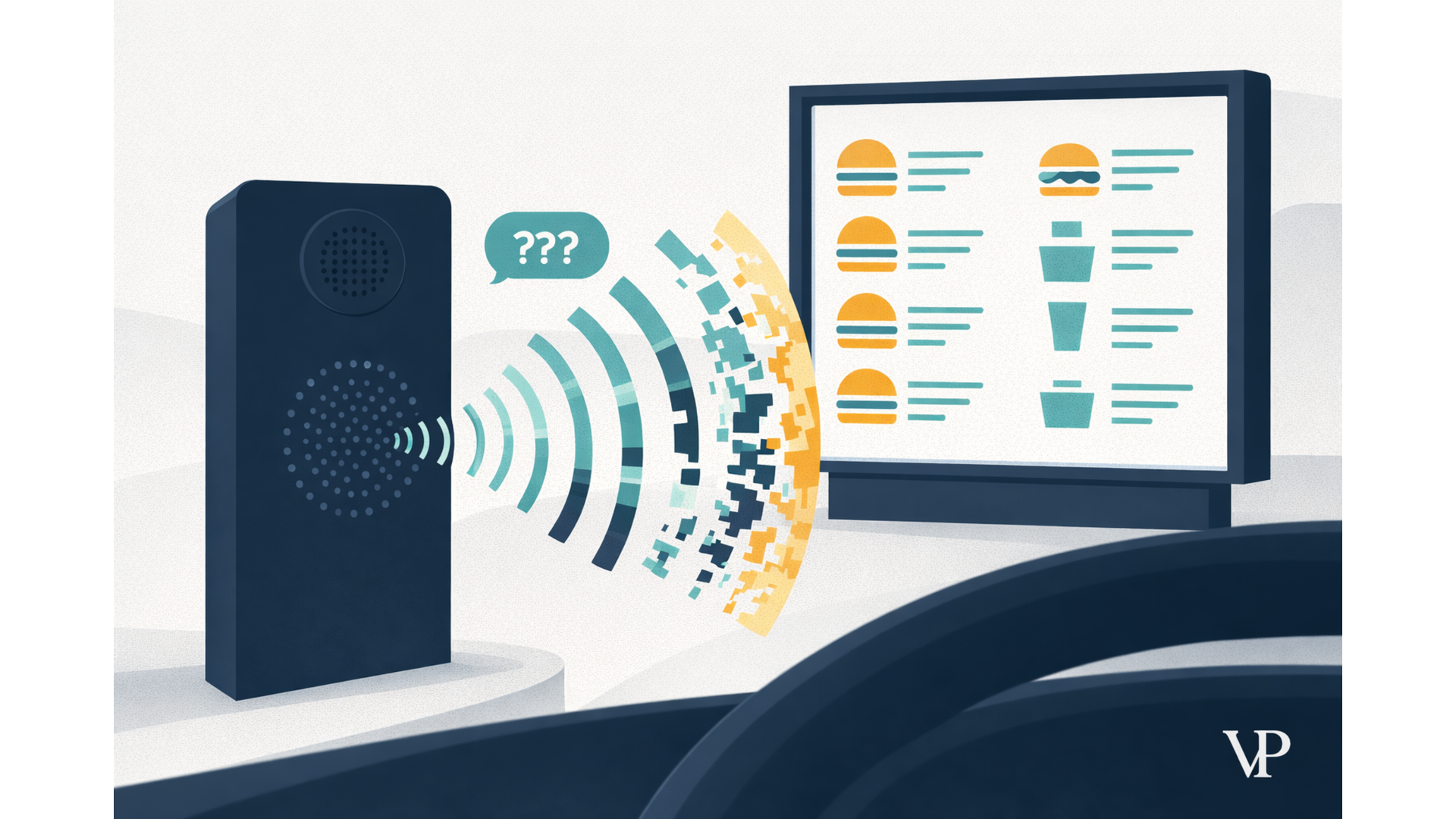
A customer pulls up to a Wendy's drive-thru, says "I'd like a Dave's Double with no pickles," and the AI bot responds by suggesting Frosty flavors. She repeats herself. The bot cuts her off mid-sentence. On the third attempt, she shouts "AGENT" to get a human being.
This isn't a hypothetical. It's happening right now across Wendy's FreshAI locations — and the company is expanding the system to 500-600 stores by the end of 2025. The drive-thru voice AI problem isn't that the technology doesn't work. It's that the architecture underneath it was never built for the real world.
I've spent the past two years studying why enterprise voice AI deployments fail at the point of contact. What I've found is that most providers in the quick-service restaurant space are doing something I call the "API Wrapper" approach — plugging a standard microphone into a third-party large language model and calling it innovation. It's fast to deploy. It demos beautifully. And it falls apart the moment a diesel truck idles next to the speaker box.
The Expansion Paradox: Great Metrics, Broken Experience
Wendy's reports an 86% success rate for orders handled without human intervention. On a dashboard, that looks impressive. But flip it around: 14% of transactions fail. In an industry where drive-thru accounts for 75-80% of total sales, that's not a rounding error — it's a crisis hiding in plain sight.
The reason Wendy's is expanding anyway reveals something I think about constantly: the gap between management metrics and customer reality. If the AI increases average check size through consistent upselling, the friction experienced by a significant minority of customers gets treated as an acceptable cost of doing business. I call this "Management by Average," and it's the most dangerous pattern in enterprise AI deployment.
When your AI works for 86% of customers, you don't have a success story. You have a system that discriminates against the other 14%.
The customers who fall into that 14% aren't random. They're disproportionately people with accents, speech disfluencies, complex orders, or anyone who pauses to read the menu. The AI isn't failing randomly — it's failing systematically against specific populations.
The Real Problem Isn't the AI's Brain — It's the AI's Ears
When I first dug into the FreshAI complaints, I assumed the issue was the language model itself — that it couldn't understand menu items or handle customizations. I was wrong. The most frequent complaint is far more basic: the bot cuts people off mid-sentence.
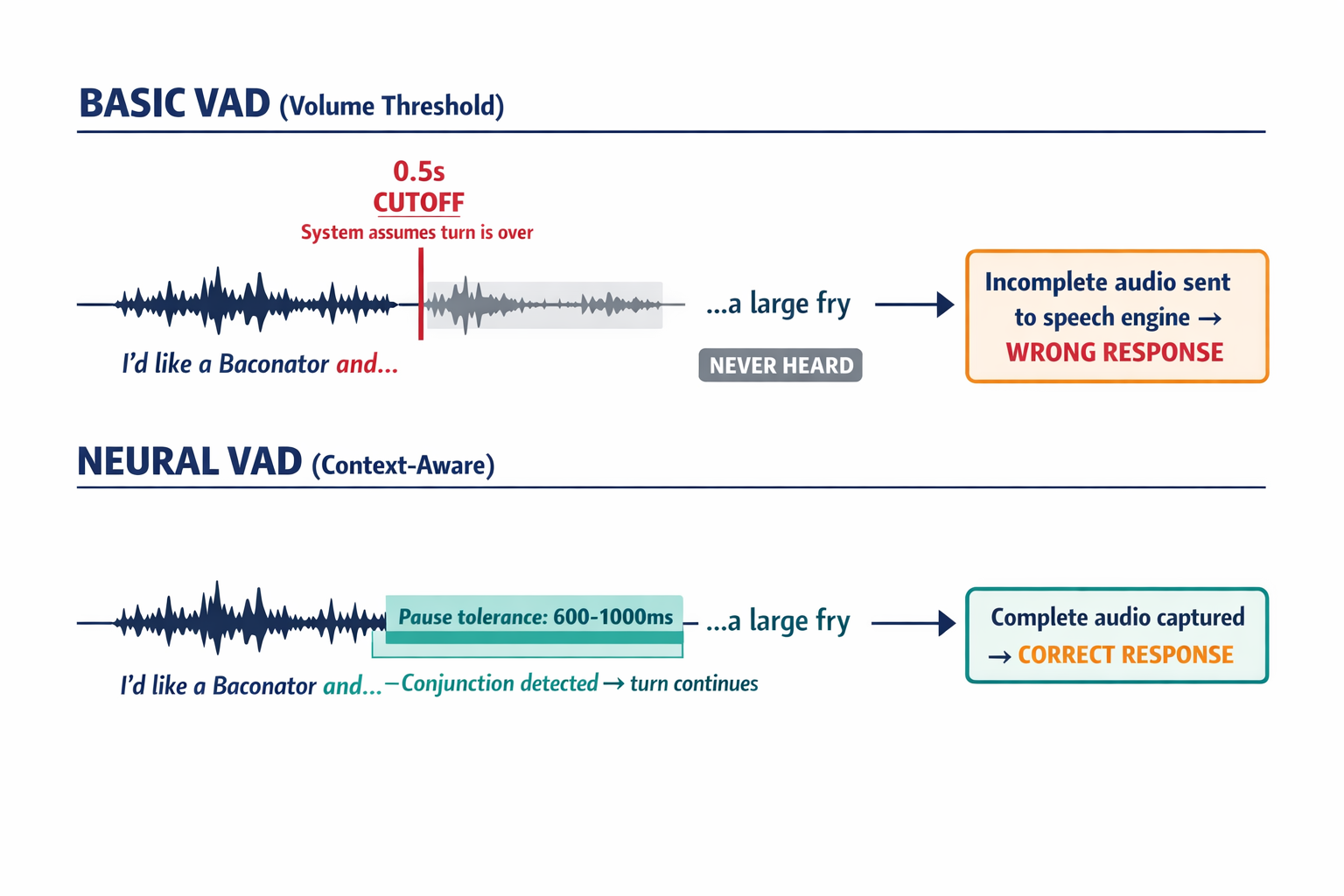
This is a Voice Activity Detection problem — VAD, the layer that decides when you've started talking and when you've stopped. Think of it as the AI's ears, separate from its brain. Most wrapper solutions use simple volume-based detection: if the sound level drops, the system assumes you're done talking. That works fine in a quiet office. In a drive-thru, it's a disaster.
When a customer pauses for half a second to glance at the menu board, the system interprets that silence as "I'm finished" and fires off an incomplete audio fragment to the speech recognition engine. The result is gibberish in, gibberish out. The bot responds to something you never said, you get frustrated, and the cycle repeats.
We explored this problem in depth in our interactive analysis of voice AI architecture, and the data is stark: standard speech recognition accuracy drops from 97% in lab conditions to unusable levels in real-world drive-thru environments. The gap between the demo and the deployment is enormous.
What does enterprise-grade VAD actually look like? Instead of a binary volume threshold, you need neural models that recognize the specific frequency patterns of human speech and assign probability scores. You need dynamic pause tolerance — 600 to 1000 milliseconds instead of a rigid 500ms cutoff — so the system can handle a "thoughtful pause" without panicking. And you need what we call context-aware turn-taking: if someone says "I'd like a Baconator and..." the word "and" tells the system the turn isn't over, even if there's a full second of silence afterward.
A half-second pause at a drive-thru isn't silence. It's a customer reading the menu. Any system that can't tell the difference isn't ready for deployment.
80 Million People Can't Use This Technology
The finding that hit me hardest wasn't about noise or latency. It was this: customers who stutter have described FreshAI as "unusable."
Stuttering affects over 80 million people worldwide. It shows up as sound repetitions ("b-b-b-baconator"), prolonged sounds, or silent blocks mid-word. Every one of these patterns breaks standard speech recognition. A silent block gets interpreted as end-of-turn, so the bot interrupts. Repetitions confuse the system's language processing. Prolonged sounds get misrecognized entirely — "Mmmmilk" becomes "Silk."
Research on Conformer-based speech recognition models — the kind that power most commercial systems — shows that performance on disordered speech can degrade so severely that some models return what researchers call negative BERTScores. In plain English: the system doesn't just get the words wrong. It loses all semantic meaning. It has no idea what you said.
I remember the moment my team showed me the data on this. We were looking at Character Error Rates across different speech patterns, and I asked a question that felt obvious in retrospect: "Has anyone tested these systems with people who actually stutter?" The answer, overwhelmingly, was no. The training data for commercial speech recognition is almost exclusively "standard" U.S. English — well-articulated, minimal pauses, no disfluencies. The bias isn't intentional. It's architectural. And that makes it harder to fix.
Solving this requires a specialized training pipeline. You fine-tune self-supervised models on re-annotated disfluent speech datasets. You use synthetic disfluency insertion — taking fluent transcripts, adding blocks and repetitions, synthesizing them into audio — to give the model exposure to the full range of how humans actually speak. It's not a feature you bolt on. It's a fundamental design choice you make at the beginning, or you retrofit painfully later.
Why Cloud-Only Architecture Can't Deliver Real Conversation
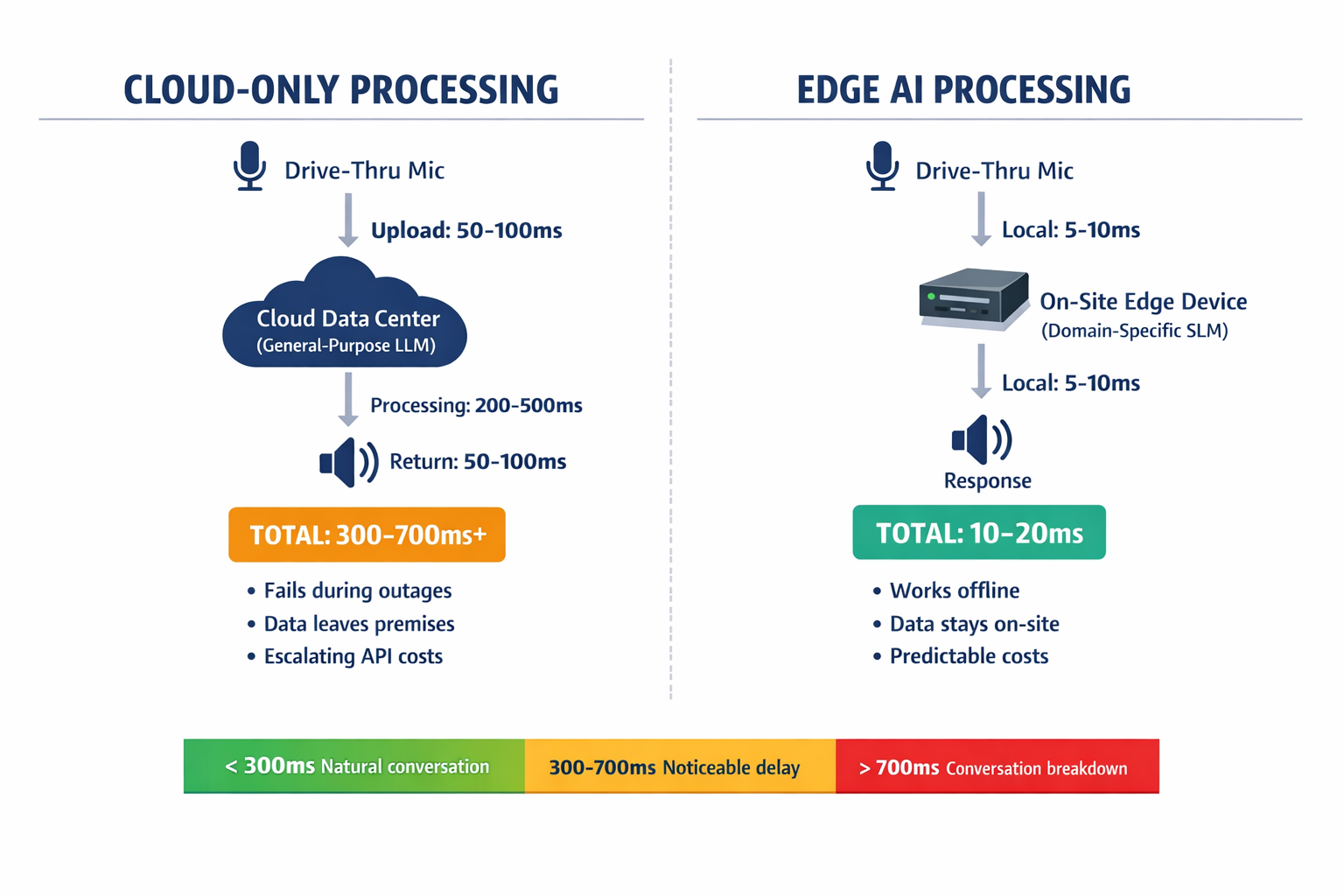
Every word spoken at a Wendy's drive-thru travels from the microphone, across the public internet to a Google Cloud data center, gets processed, and travels back. That round trip consumes 100-500 milliseconds before the model even starts generating a response.
The gold standard for voice AI that feels natural is sub-300 millisecond response time. At that speed, conversation flows. Once you cross 700-900ms, the interaction starts breaking down — you get overlapping speech, mutual interruptions, the awkward dance of two parties who can't tell when the other is done talking. By two seconds, it feels like a bad international phone call.
This is why we've been building toward edge AI — processing voice locally on specialized hardware at the restaurant itself. The latency difference is dramatic: 5-10 milliseconds locally versus 100-500ms over the network. But latency is only part of the story. Edge processing means the system works during internet outages. It means customer voice data doesn't travel to a third-party data center. And it means predictable costs instead of escalating cloud API fees.
The other piece is model size. A general-purpose large language model knows how to write poetry, debate philosophy, and generate code. It doesn't need any of that knowledge to take a drive-thru order. A domain-specific Small Language Model, trained specifically on a restaurant's menu and ordering patterns, achieves the same business accuracy with a fraction of the computational load — and runs three times faster. An SLM trained on Wendy's menu doesn't need to know that "Dave's Single" could theoretically refer to a music album. It just needs to know it's a burger with specific customization options.
For the full technical breakdown of edge versus cloud architecture in voice AI, see our detailed research.
The Regulatory Wall Is Already Here
There's a dimension to this that most QSR operators haven't fully processed yet. The regulatory environment around AI accessibility shifted dramatically in early 2025.
CAN-ASC-6.2:2025 is the first dedicated accessibility standard for AI systems. It mandates that people with disabilities be involved in the design, testing, and governance of AI. It requires organizations to track performance metrics by disability status. It demands that users have a meaningful choice to decline AI interaction in favor of a human — not by shouting "AGENT" into a speaker box, but through a dignified, designed pathway.
The European Accessibility Act began enforcement in June 2025 with steep fines. The Americans with Disabilities Act already prohibits discrimination in public accommodations, and new interpretations specifically target digital barriers for people with speech disabilities.
Retrofitting an AI system for accessibility across 600 locations costs roughly five times what it would have cost to build it right from the start.
From 2023 to 2025, the share of S&P 500 companies reporting AI as a material risk jumped from 12% to 72%. Reputational damage tops the list of concerns. For a consumer brand, a viral video of your AI system failing a customer who stutters isn't a PR hiccup — it's a category-defining moment.
What About the "Just Add a Human Fallback" Argument?
I hear this constantly: "We'll just have a human step in when the AI fails." The problem is how that handoff actually works in practice. If the only escape hatch is a customer shouting a keyword, you've already lost. The customer is frustrated, the line behind them is growing, and the "efficiency" the AI was supposed to create has evaporated.
A real human-in-the-loop system is proactive, not reactive. It monitors confidence scores in real time and escalates before the customer becomes irate. It uses the AI to handle simple, transactional requests — "Large Coke, nothing else" — while routing complex orders or detected friction to a human agent who already has context on the conversation so far.
And then there's the safety question. When voice AI systems go wrong, they go wrong publicly. In 2024, a delivery company's chatbot was coaxed into writing poems criticizing its own employer. In August 2025, a major tech company's chatbot leaked live session cookies to researchers through a simple prompt trick. In the drive-thru context, imagine an AI hallucinating a price, confirming an order that was never placed, or — worst case — revealing information about a previous customer's transaction. These aren't theoretical risks. They're the natural failure modes of systems deployed without proper guardrails.
What This Means If You're Building or Buying Voice AI
I want to be direct about what I think the Wendy's FreshAI expansion reveals. It's not that voice AI in quick-service restaurants is a bad idea — the drive-thru is arguably the single best use case for this technology. It's that the current generation of solutions, built on the API wrapper model, has hit a ceiling that no amount of scaling will break through.
If you're evaluating voice AI for any customer-facing application, here's what I'd push on:
Ask about VAD architecture specifically. If your vendor can't explain their endpointing logic and pause tolerance settings, they're using defaults that will fail in noisy environments.
Demand accuracy metrics across diverse populations. Overall accuracy is meaningless if the system fails systematically for specific groups. Ask for disaggregated data.
Understand where the processing happens. Cloud-only architectures have a latency floor you can't engineer around. Ask about edge deployment options.
Test with real humans in real conditions. Not actors in a studio. Real customers, real accents, real background noise, real hesitation.
The companies that get voice AI right over the next two years won't be the ones who deployed fastest. They'll be the ones who understood that the hard problem was never connecting to an API. It was building a system that understands every customer — the one with a clear voice ordering a #1 combo, and the one with a stutter trying to order the same thing on a windy day.
I'd genuinely like to hear from anyone navigating this transition. What's your experience been — as a builder, a buyer, or a customer on the other side of the speaker box?