Your Optical Sorter Is Blind to Black Plastic. We Stopped Calling It a Software Problem.

The first time I really understood the problem, I was standing at the end of a residue line, watching.
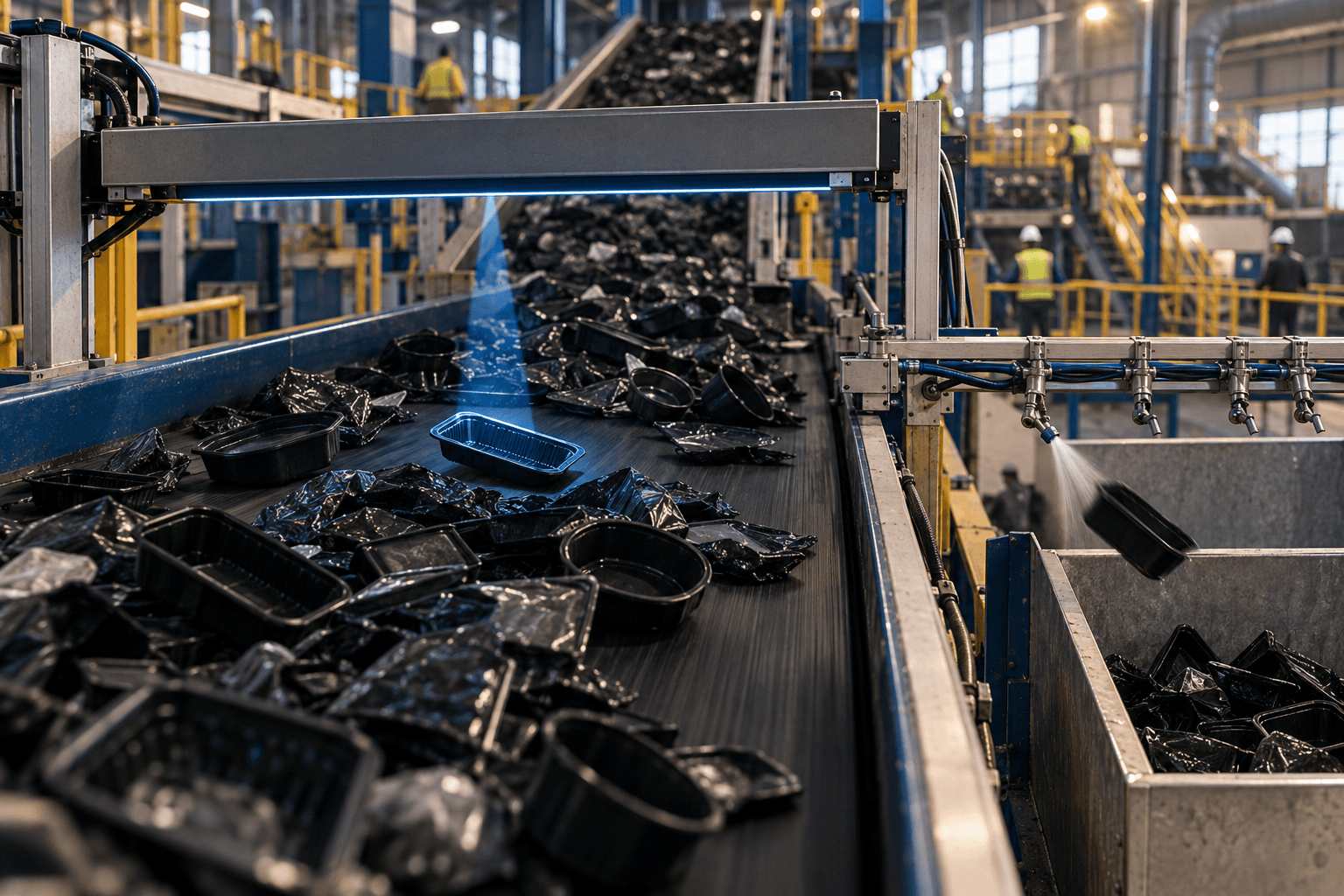
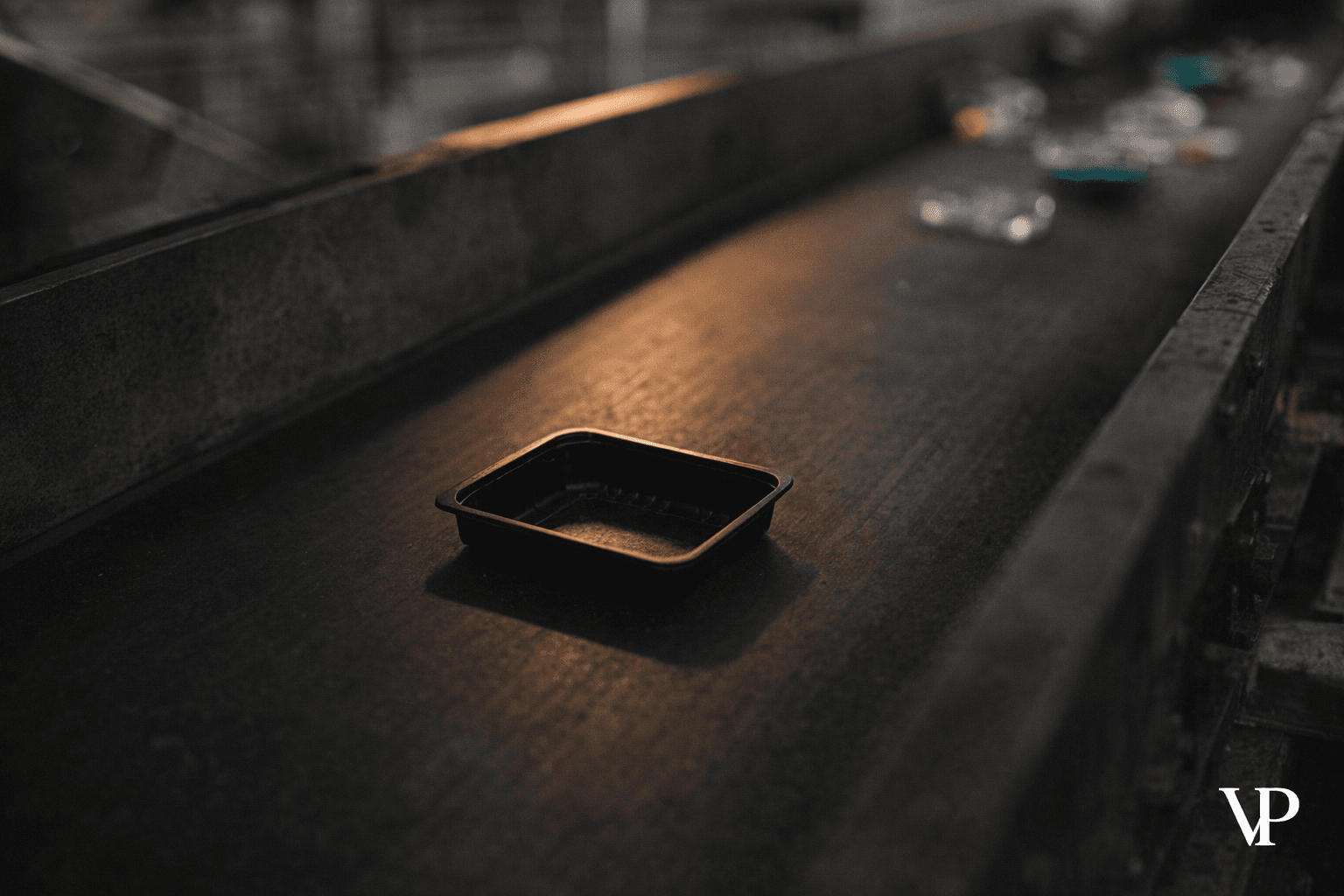
A black polypropylene tray came down the belt, rode past a row of optical sorters that had cost the better part of half a million dollars, and dropped into the reject stream with everything else headed for landfill. The ejector above it never fired. Not because the software made a bad call. Because the software never saw anything at all. To that sorter, a black tray on a black rubber belt is a void. There is nothing there to classify.
That tray is worth recovering. Black PP and PE and ABS make up somewhere between 3 and 15 percent of a typical plastics stream, depending on the region, and almost all of it goes to residue. For a mid-size facility that adds up to a number with a comma in it, paid out every year as a landfill gate fee on material a buyer would happily pay for. This is the gap we built Veriprajna's materials recovery and black plastic sorting work around: not "bring AI to recycling," because recycling already has more AI than most industries, but solve the one thing all that AI keeps walking past.
I went into it convinced this was a machine-learning problem. I came out understanding it was a physics problem wearing a machine-learning costume, and that the most valuable thing we could do was sometimes tell a plant director to spend less money than they expected.
Why Does a Half-Million-Dollar Sorter Go Blind on Black Plastic?
Standard optical sorters read polymers with near-infrared light, in the 0.9 to 1.7 micron range. The trick is elegant: every plastic has a molecular fingerprint, and the bonds inside it, the carbon-hydrogen and oxygen-hydrogen stretches, absorb specific NIR wavelengths in a pattern the sensor can match against a library. TOMRA, Machinex, Pellenc, the whole high-end field works on some version of this.
Carbon black breaks it completely. The pigment absorbs essentially all near-infrared light before it can reach those molecular bonds and bounce back. The detector receives nothing. You can retrain the model all you want; there is no signal in the input to learn from.
No amount of AI training fixes a zero-signal input. The photons never reach the detector. This is sensor physics, not a firmware update.
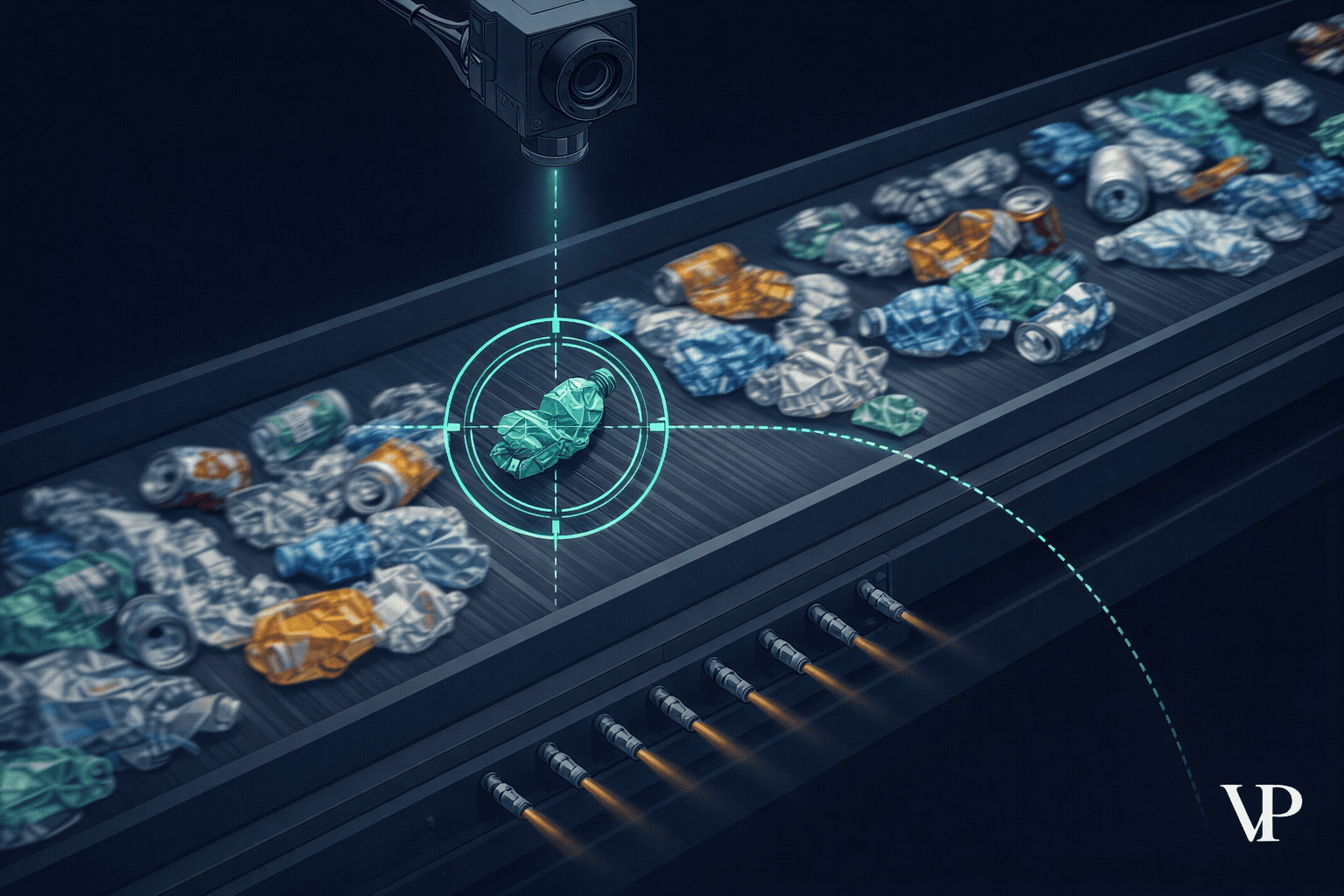
That sentence is the whole reason a different approach exists. The fix is to change which part of the spectrum you look at. Mid-wave infrared, roughly 2.7 to 5.3 microns, reads the fundamental vibrations of polymer molecules rather than the faint overtones NIR picks up, and as wavelength climbs, carbon black's grip loosens. By about 3 microns the pigment goes effectively transparent, and the carbon-hydrogen stretch peak at 3.4 microns comes through sharp and unambiguous. A black tray that was a hole in the NIR view becomes a clean, jagged signature in MWIR. Polystyrene's aromatic carbon-hydrogen modes separate cleanly from the aliphatic bands of PE and PP. The camera we deploy, a Specim FX50, captures 154 spectral bands across that range. It isn't seeing black shapes. It's reading chemical composition at conveyor speed.
When I first sketched this out, I thought the story ended there. New camera, new spectrum, problem solved. It did not end there.
The Number the Brochure Doesn't Want You to See
Specim's marketing materials, and most of the press around MWIR sorting, point you toward accuracy figures near 99 percent. That was the number in my head when we started building the classifier. We trained a 1D convolutional neural network on the spectra, watched it perform beautifully on clean reference samples, and I let myself believe we were most of the way home.
Then we ran it against the kind of input an actual MRF sees. Not pristine pellets. Whole objects, scuffed, food-soiled, label-covered, overlapping on a moving belt, with the dust and grime that coats everything in a recycling plant. The balanced accuracy came back at 83.4 percent.
I want to be honest about how that landed, because it was the most important moment in the project. My first instinct was that we had done something wrong, that there was a bug in the pipeline, a calibration we had skipped. There wasn't. A peer-reviewed paper published in Resources, Conservation and Recycling in January 2026, on exactly this problem, MWIR plus a CNN for black plastic identification, reported the same kind of figure on real waste. The 99 percent was a lab number. 83 percent was the world.
The gap between the lab demo and the dirty belt is where most recycling technology quietly dies. We decided to live in that gap instead of hiding it.
That reframed everything about how we pitch. We stopped promising near-perfect recovery and started talking about realistic recovery rates, the kind that still pay for the system several times over, because even at 83 percent the economics are not close. A 50,000-ton-per-year facility running 5 percent black plastic is sitting on roughly 2,500 tons of recoverable polymer. At prevailing recycled-PP prices and avoided landfill cost, the honest, conservative case lands around 2.2 to 2.7 million in annual P&L impact, against a retrofit cost in the low hundreds of thousands. You do not need 99 percent for that math to work. You need to stop pretending you have it.
"Just Buy the Faster Hardware" Was My Wrong Instinct
The second thing I got wrong was about speed.
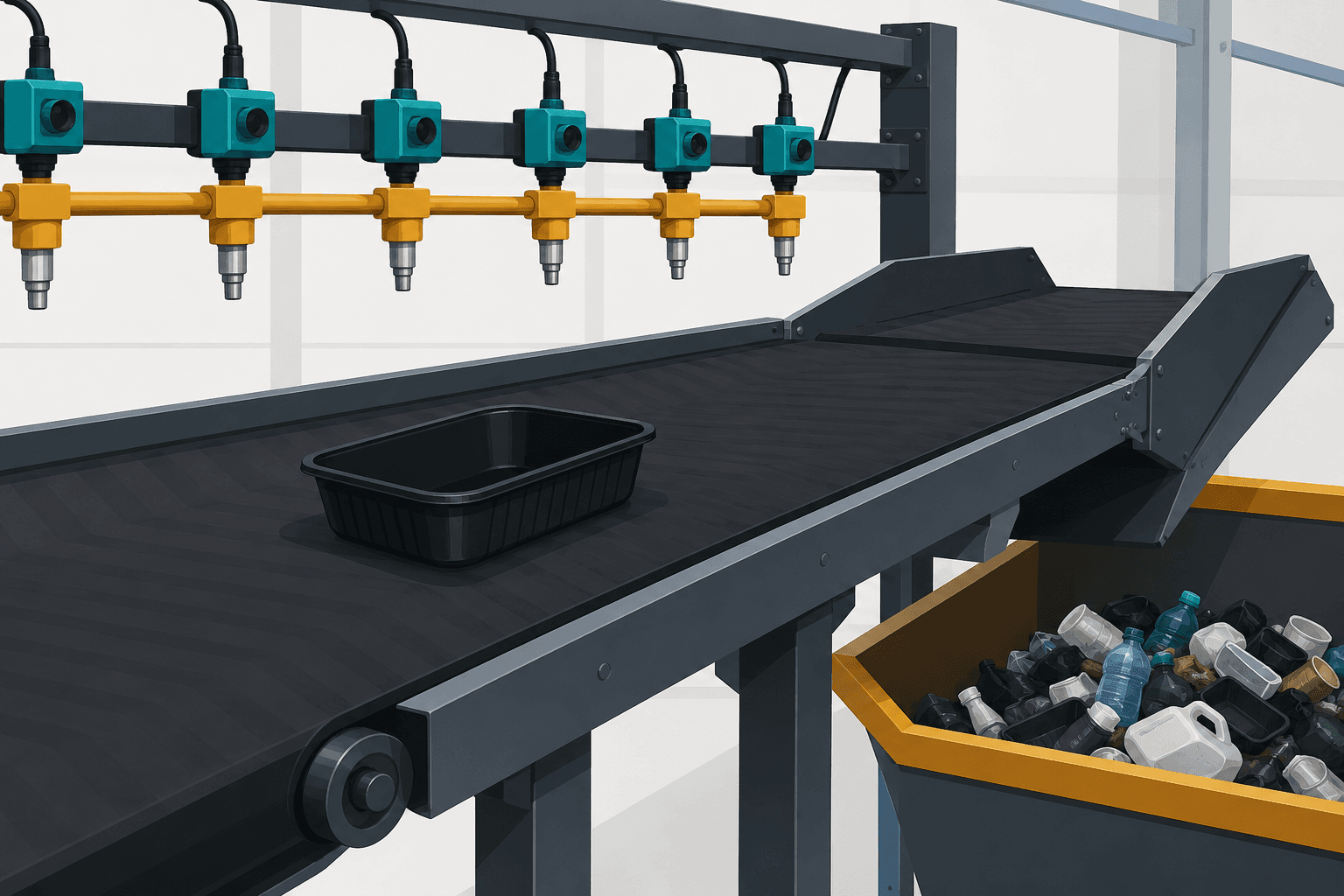
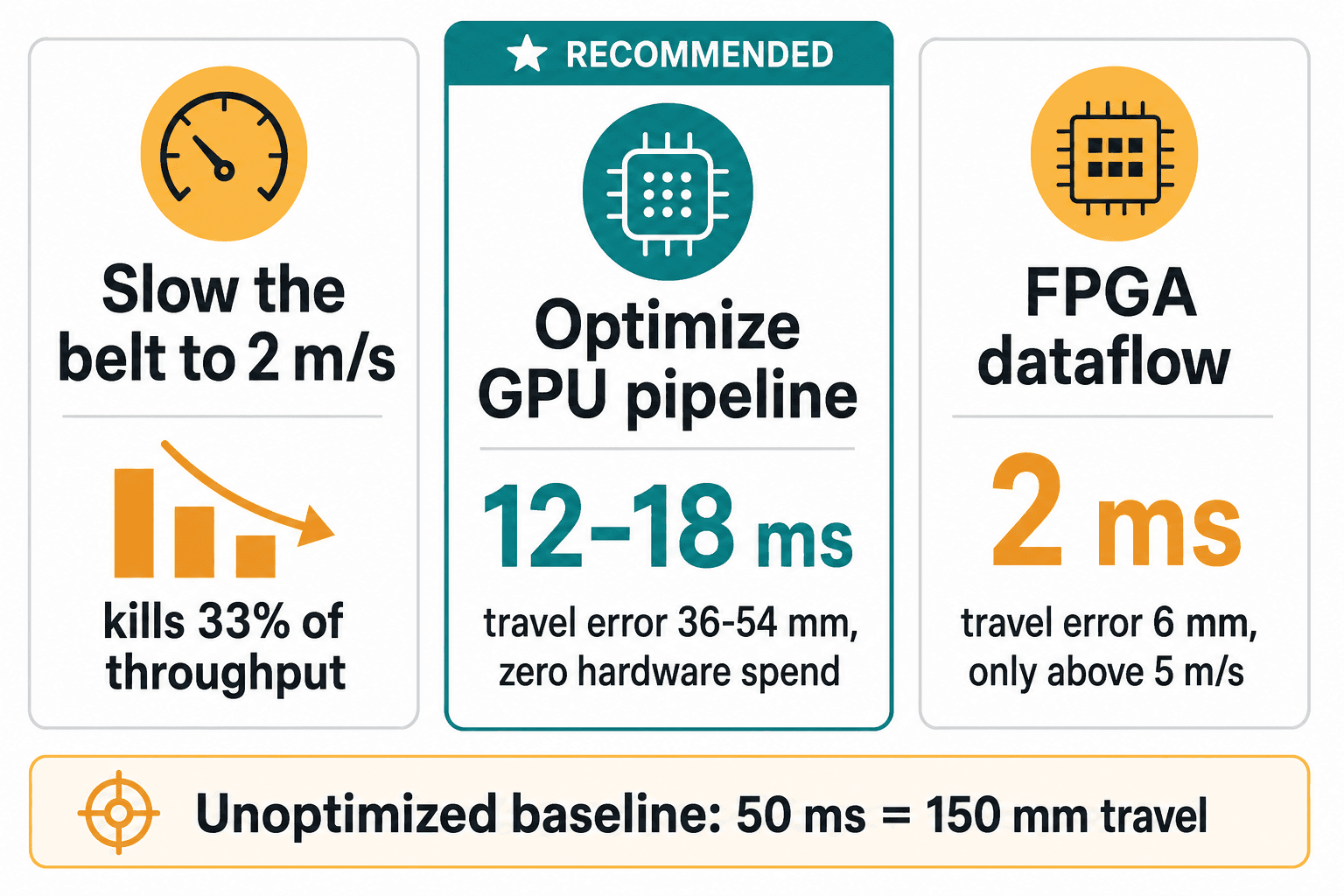
There is a real engineering question buried in any sort line: how fast can you go from "the camera saw a black PP tray" to "the air valve fired at exactly the right spot"? If that latency is too long, the belt has carried the object past the firing window, and the ejector either misses or takes the tray plus two neighbors, and your purity collapses. I assumed, coming in, that the answer to this was always faster, more deterministic hardware, an FPGA dataflow pipeline that could hit around 2 milliseconds with no jitter. We even started designing one.
Then I actually ran the numbers for a representative facility, and they embarrassed me. Picture a 50,000-ton plant, a 1.2-meter belt at 3 meters per second, ejector nozzles pitched 12.5 millimeters apart, and an unoptimized edge-GPU pipeline taking 50 milliseconds. Belt speed times latency is 150 millimeters of travel before the valve fires, and with jitter the real firing window smears across 200 to 260 millimeters, far wider than a 60 to 90 millimeter target. Of course purity drops. But the fix is not the FPGA.
The fix, for that facility, is to optimize the GPU pipeline, TensorRT, batch size one, kernel fusion, half-precision, which drops latency to 12 to 18 milliseconds. Now your travel error is 36 to 54 millimeters and the system works, with zero hardware spend, just engineering. The FPGA route, 2 milliseconds and 6 millimeters of error, only earns its cost above roughly 5 meters per second belt speed, and it carries months of specialized engineering with it. Most plants are not running 5 meters per second.
The honest answer to "do I need the expensive deterministic hardware" is usually no, and the only people who'll tell you that are the ones not selling it to you.
So we built that math into a discovery engagement. We run it first, before proposing anything, and more often than not we tell the client the cheaper answer. It earns us less. It also means the next plant director hears about us from the last one.
What Happens When the MWIR Camera Dies?
The first meeting is about whether MWIR can see black plastic. The second meeting is always the same question, and it is the one that separates people who have actually fielded this equipment from people selling slides: what happens when the camera dies?
It is a fair fear. The Specim FX50 cools its detector to around 77 Kelvin with an integrated Stirling cooler, and that cooler is the part that wears out. The datasheet says 10,000 hours. In a real MRF, with dust ingress and constant vibration, plan on 7,000 to 8,000. At 16 hours a day, that is a cooler service roughly every 14 to 18 months, and the replacement lead time from Specim runs 12 to 16 weeks. If your recovery line is dead for a financial quarter because a cryocooler is on a boat, you have not bought a solution, you have bought a liability.
So the contingency is part of the build, not an afterthought. The camera mounts on a hot-swap bracket so it comes off in half an hour, and the coolers run on a rotation, where one gets pulled for refurb before it fails and comes back as the spare for the next cycle. While a unit is out, a degraded fallback mode runs RGB segmentation only, at lower accuracy, so the line never fully stops. Underneath all of that sits a second qualified sensor source, Telops and IRCameras among them, because nearly every MWIR pitch in this market quietly depends on one camera from one company, and a facility betting millions on recovery deserves better than a single point of failure it didn't know it had.
Where the Field Stops, and Why
I want to be precise about the competition, because the recycling-AI space is genuinely crowded and I'm not pretending otherwise. TOMRA has run deep learning at the edge since 2022 and has thousands of units in the field. The reason this gap still exists isn't that the incumbents are asleep. It's that each of them stops just short of it, for structural reasons.
The ones who can see black plastic sell it bundled. TOMRA's Autosort Black is a separate machine inside a line that starts around 450,000 to 650,000 euros, with closed software you cannot license onto hardware you already own. Steinert's UniSort BlackEye genuinely runs MWIR, but it's tuned as a finishing sorter for clean flake at about a ton an hour, not for contaminated whole-object input off a primary stream. The ones who can't see it are honest about it in different ways: Machinex's hyperspectral line works in SWIR, which hits the same carbon-black wall as standard NIR; Pellenc's profile detection can flag "a black thing in the stream" for contaminant removal but won't tell you black PP from black PS; AMP's robotic pickers and Greyparrot's analyzers do real work, picking and measuring respectively, but on RGB cameras that can't classify polymer at all.
Every vendor in this market is excellent at something adjacent to your black plastic problem. None of them sells the retrofit that solves it directly.
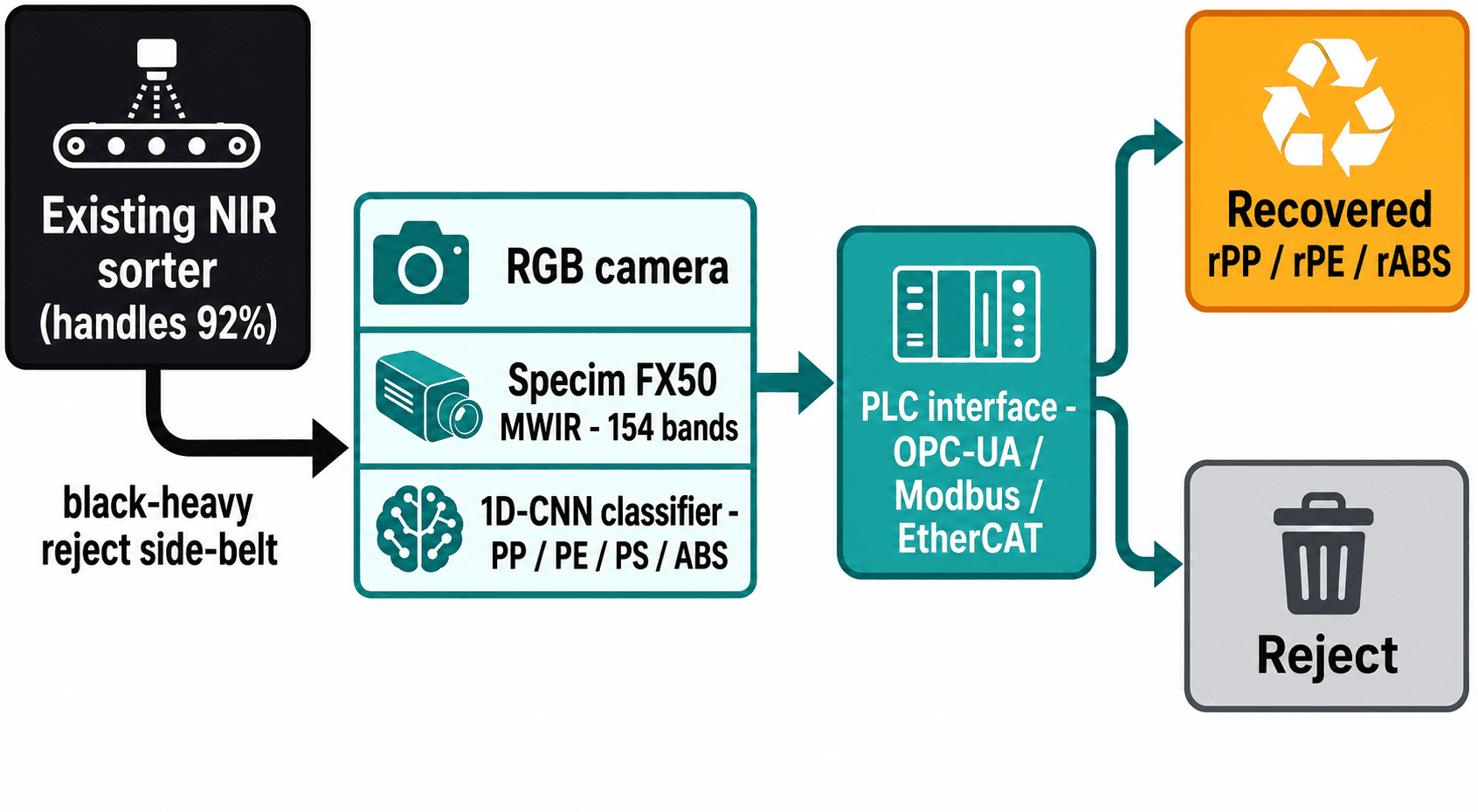
That is the whole opening. We don't replace the sorter someone already paid for. We add a sensing station, usually on the side-belt that catches the black-heavy reject, with an RGB camera to find object boundaries, the FX50 to classify the spectra inside them, and a clean interface into the existing machine's PLC over OPC-UA, Modbus or EtherCAT to fire the existing ejectors. The buyer keeps the 92 percent of the stream their current line handles well and recovers the slice it was built to ignore.
And there's a harder, higher-margin version of this for electronics recyclers. End-of-life electronics are full of black ABS, much of it loaded with brominated flame retardants that RoHS bars from going back into new equipment, and 40 to 50 percent of captured WEEE plastics never get properly recycled because of it. X-ray fluorescence can read the bromine but not the polymer; MWIR reads the polymer but not the bromine. Fuse the two into one classification head, running at about 5 milliseconds, and you can split clean recycled ABS from flame-retardant rejects in a single pass, where most facilities still run two. Used together the sensors strip up to 98 percent of the brominated plastics out of the stream. That sensor-fusion problem is largely unsolved at production grade, which is exactly why it's worth building.
The Black Plastic Problem Has a Fifteen-Year Clock
People who follow packaging will raise the obvious objection: why build infrastructure for carbon black at all, when brands could just switch to NIR-detectable black pigments and the problem disappears at the source? It's a real movement. UPM launched a bio-based, NIR-detectable black at the end of 2025; Cabot has food-contact-compliant alternatives; Ampacet has masterbatches tuned for sortability.
I looked hard at this, because if substitution were about to wipe out the problem, building an MWIR practice would be a bad bet. It isn't. Standard carbon black runs around 0.20 euros a kilogram; the detectable alternatives are three to six times that, before the cost of requalifying food-contact packaging. Adoption since 2018 has been slow, best estimates put detectable black under 10 percent of FMCG black packaging, and the legacy stream has nowhere to go: automotive interiors aren't switching, electronics housings aren't switching, cost-sensitive private-label packaging isn't switching.
So this is a 15-to-20-year transition, not a cliff. The honest framing, the one I actually believe, is MWIR recovery now while the brands slowly convert, and the same line keeps recovering the long tail for two decades after. Meanwhile the regulatory floor is rising underneath all of it: California's SB 54 begins pulling roughly 500 million a year from packaging producers, with the first reporting deadline at the end of May 2026, and the EU's packaging rules will require recyclability grades and steeply rising recycled-content targets, 30 percent in plastic packaging by 2030, that simply cannot be met if black plastic keeps going to landfill. The recovered material isn't just revenue anymore. It's compliance.
What I Tell People Who Ask If They Even Need Us
Two questions come up almost every time, and I'd rather answer them here than in a sales call.
The first is whether they should just hire one of the big consultancies instead. They can, and for some questions they should. But an Accenture or Capgemini engagement runs into the millions and produces a vendor-selection matrix and a roadmap. It does not write the 1D-CNN, calibrate a cryocooled sensor against your specific belt background, or commission the PLC interface. We are smaller than the system integrators, faster than building the capability in-house, where, frankly, you cannot easily hire the people who can qualify a Stirling cooler or write a tracking algorithm against an EtherCAT controller, and more focused than the OEMs whose job is to sell you their next machine.
The second question is the one I'm proudest of how we answer: do they even need this? Sometimes the answer is no. A facility under about 25,000 tons a year, with a thin black-plastic share, in a region where landfill is cheap, may never see the payback. We say so and walk away. A platform vendor structurally cannot tell you that you're not a fit. We can, and the projects that come back to us are the ones where the math actually closes.
The recycling industry spent the last few years being sold "AI" as if it were a single thing you either had or didn't. It isn't. The black tray falling into the reject bunker doesn't care how many neural networks are running upstream. It cares whether anything in the building is looking at it in a wavelength where it exists. Most plants, right now, are not. That is a smaller, more solvable problem than the brochures make it sound, and a more valuable one than the residue report will ever tell you. If you want to see how we'd close the math on your line, the full breakdown is here.