What an AI Model's Existence Leaves Unproven

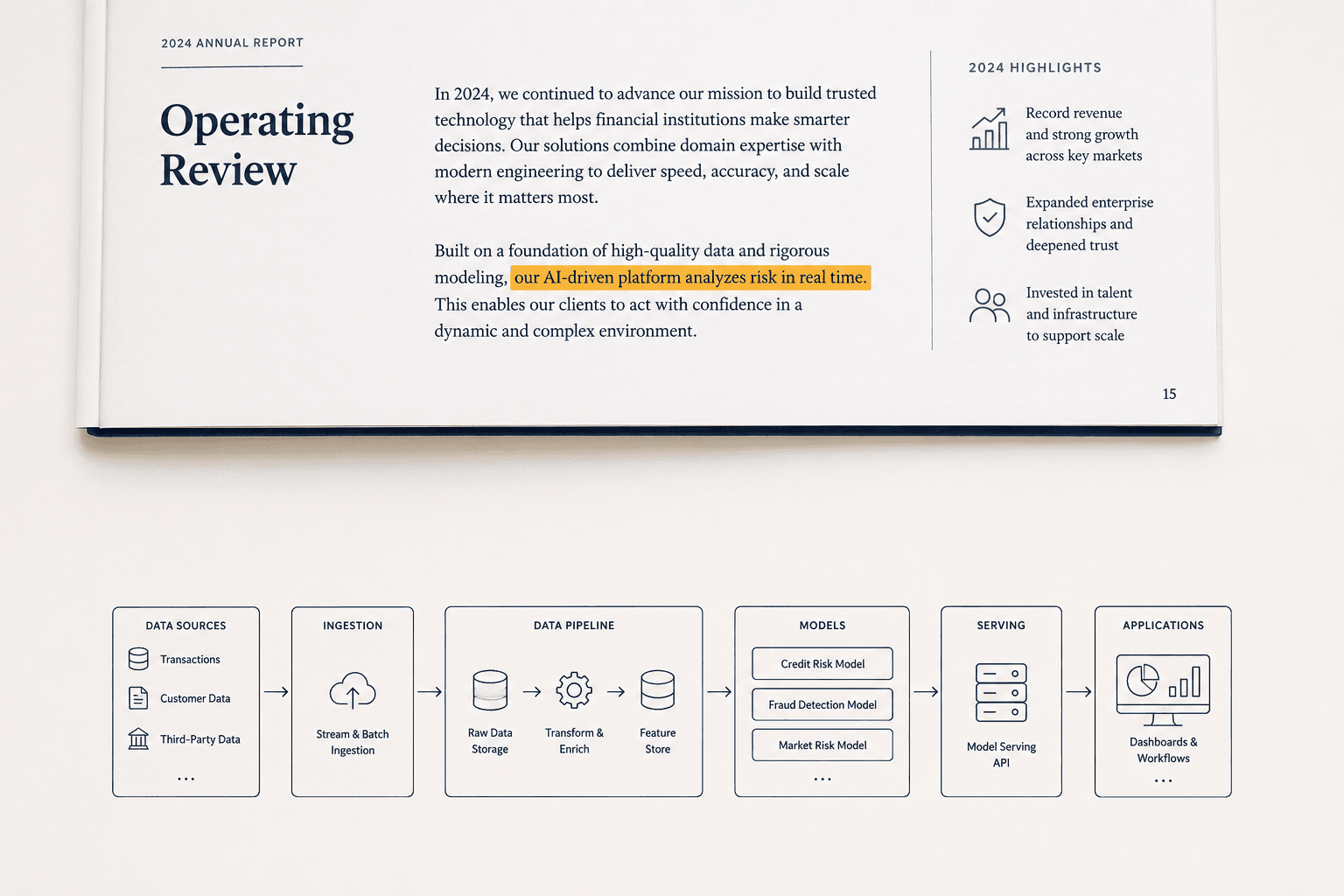
A team can produce a model card and still leave its marketing claim unanswered. The card may document that a model exists. A sentence saying the business is “AI-driven” makes a further commitment about the model's role in the work. I want the review of that sentence to reach the operational record before anyone treats the existence of the technology as sufficient support.
Disclosure: This article was drafted using generative AI.
That design position sits behind ClaimLens, our local demonstration of linking AI claims to supplied technical records. The example here is Nimbus Capital AI, a synthetic company with synthetic disclosures and logs. It illustrates a review problem; it does not establish how any actual investment firm operates or whether a disclosure complies with law.
The distance between deployed and driving
Nimbus says: “We employ AI-driven portfolio optimization across all discretionary managed accounts.” Its supplied model record says an optimization model is deployed. Its operational log says the model's output influenced 1.5% of allocation decisions. ClaimLens assigns this claim “Needs proof” under its configured rule for low operational influence.
The existence record answers a useful question. There is a model to investigate. The log answers a different one: how often its output influenced the recorded allocation decisions. Neither fact should disappear because the other is inconvenient.
The sentence reaches further than those records. “AI-driven” suggests a role in determining the work. “Across all” introduces breadth. A deployed model, by itself, does not explain either commitment. The 1.5% figure gives a reviewer a concrete reason to ask how the model participates in the process and how that participation is distributed across accounts.
I prefer a review that keeps this gap explicit. Approving the broad wording because the model is present would let a narrow piece of evidence carry a much larger promise. Declaring that no AI is used would discard the evidence that the model exists and sometimes influences decisions. “Needs proof” preserves the question the supplied records have left open.
A low percentage still needs interpretation
The harder part is deciding what to ask for next. A small share of decisions does not, on its own, explain the importance of those decisions.
Consider a hypothetical workflow in which a model handles a small number of unusually consequential allocations. A count of decisions could understate its economic role. In another hypothetical workflow, the model produces a recommendation on every account, but people usually reject it. A log counting only accepted recommendations would describe a different activity from a log counting all recommendations considered. Neither possibility is established for Nimbus. They show why the meaning of “influenced” matters before using its percentage to settle the wording.
A reviewer can ask what event causes the log to count a decision, which accounts and period it covers, and whether the claimed role concerns recommendations, accepted changes, or final authority. If those definitions are missing, collecting another model card will not close the gap. The missing support concerns operational use.
This is where I put a boundary around the demo's decision. ClaimLens applies chosen rules to supplied records. It does not authenticate those records or establish that the logging method captures the role a reader would infer from the sentence. A configured “Needs proof” result can organize the investigation. The underlying measurement still needs scrutiny.
The same caution applies when a rule returns a supported result. Agreement between a sentence and a supplied record is a reason to inspect their fit. It does not establish that the record is complete, representative, or independently verified. A review system should make that distinction easy to retain when its output moves into a discussion about publication.
Three responses to the gap
For a team facing a comparable gap, the wording and the evidence can both change. The choice depends on which part of the claim the team can defend.
One response is to narrow the sentence to the activity already documented. A statement that a model is deployed is a smaller commitment than a statement that it drives portfolio optimization across all accounts. That can be a useful correction if deployment is the fact worth communicating. It also gives up the larger claim about the model's operational role. Replacing “AI-driven” with another broad adjective would leave the original question unresolved.
A second response is to establish the operational role more precisely. That might require records that distinguish recommendations generated, recommendations considered, and decisions changed, along with their coverage and definitions. This takes more work than finding evidence that a model exists. It is justified when the role of the model is central to what the team wants readers to understand. It may also reveal that the original wording needs revision even after the evidence improves.
A third response is to withhold the broader claim while the question remains open. That sacrifices a message the team may want to use. I favor that cost when the sentence's central promise depends on an operational role nobody can yet describe with adequate support. An unresolved label is useful internally only if somebody owns the follow-up; it is no substitute for a decision about the public sentence.
These are editorial and review choices, not wording that ClaimLens automatically recommends or legally approves. Their value is that they connect the unresolved evidence to a concrete next action. The team can change the promise, improve its support, or hold it back.
Preserve disagreement without losing the decision
The portfolio example also contains a disagreement. In the recorded demo, the cached AI judge calls the claim contradicted, while the configured gate retains “Needs proof.” The advice is a supplied replay, not a fresh model assessment. The judge does not change the gate's decision.
I want both outcomes available to a reviewer because the disagreement exposes a judgment: how far does this operational record take us? Calling the claim contradicted expresses a stronger conclusion than saying its support is inadequate. The person reviewing the sentence needs to see that distinction and examine the reason for it. Hiding the advisory view would remove a challenge worth considering. Replacing the recorded decision with the strongest sounding opinion would obscure how the outcome was reached.
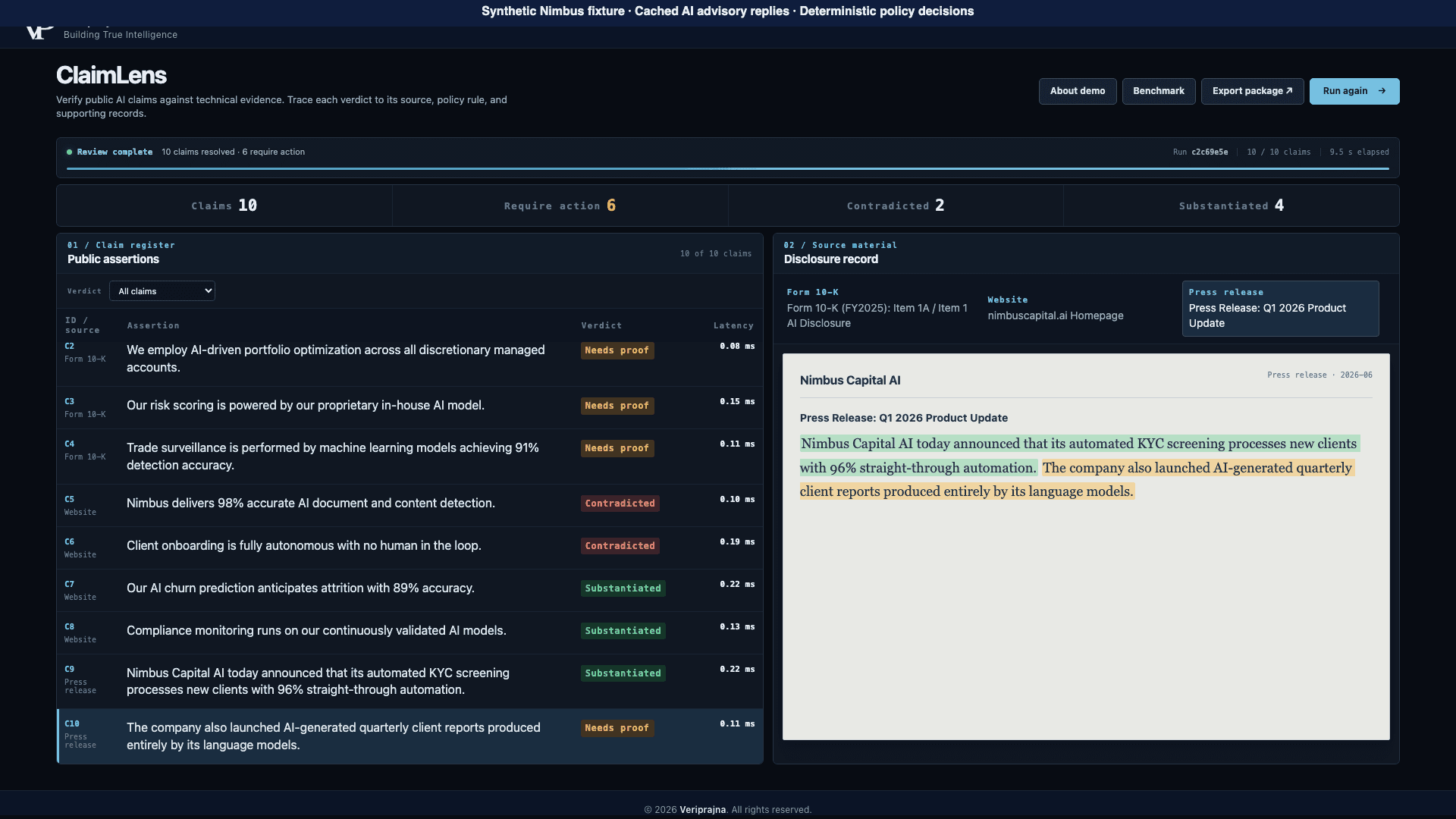
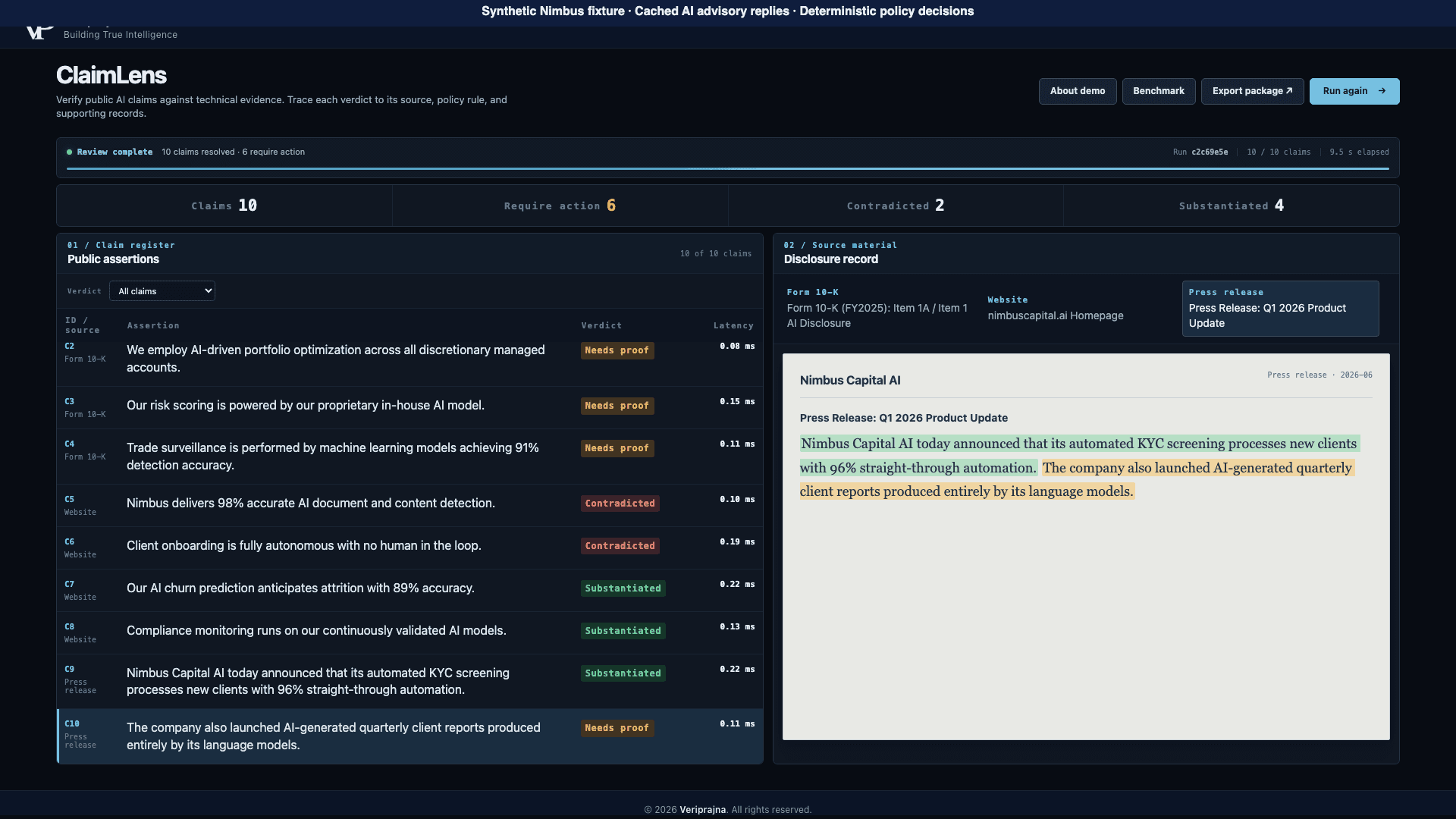
The ClaimLens explainer shows this claim-to-record workflow. Its useful unit is the sentence together with its supplied support, the recorded decision, and the reason. That combination gives marketing, engineering, and the reviewer a shared object to discuss.
Here is the founder walkthrough of the synthetic ClaimLens review.
My standard for the discussion is specific: identify the operational fact that would make the wording defensible. If the team can establish only that a model exists, that is the extent of the claim it has supported. A larger promise earns its place when the evidence explains the larger role.